
Carrying groceries is one thing. Carrying two children, a delivery box, or a full day of commercial cargo is something else entirely. On an e-cargo bike, gearing is not just about pedaling comfort. It affects hill starts, battery efficiency, motor behavior, drivetrain wear, and how confident the bike feels when loaded.
At Regen, gearing questions usually come up right after motor questions. That makes sense. Once a buyer understands the difference between a mid-drive and a hub motor, the next practical question is: how many gears do I actually need?
The short answer is this:
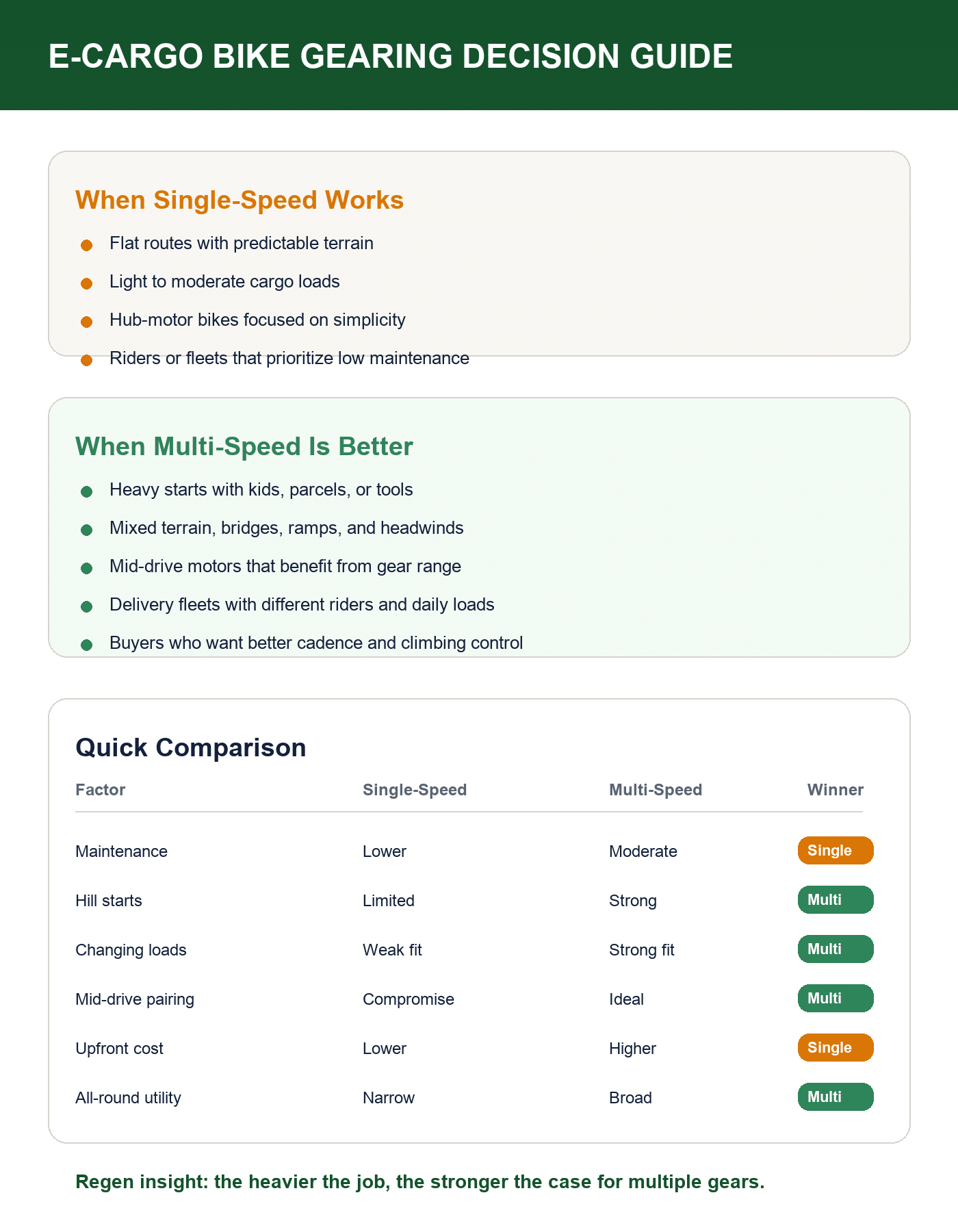
- A true single-speed setup can work for flat, predictable routes with lighter loads and riders who prioritize low maintenance over versatility.
- A multi-speed setup is the better choice for most electric cargo bikes, especially when the bike carries changing loads, operates on mixed terrain, or uses a mid-drive motor.
If you are choosing a family bike, planning a delivery fleet, or specifying components for a private-label cargo bike, this guide will help you decide.
What “Single-Speed” Really Means on an E-Cargo Bike
On a standard bicycle, single-speed means one front chainring, one rear cog, and one fixed gear ratio. There is no shifting. The drivetrain is simple, quiet, and easy to maintain.
On cargo e-bikes, the term is sometimes used more loosely. Buyers may say “single-speed” when they mean one of three things:
- A true one-gear drivetrain with no shifting at all.
- A hub-motor bike that feels less dependent on shifting because the motor drives the wheel directly.
- A very low-maintenance drivetrain, often involving a belt drive plus internal gearing, where the rider rarely thinks about gear changes.
That distinction matters. Most serious e-cargo bikes are not true single-speeds, because cargo riding creates a wider range of torque demands than a normal city bike. Starting from a stop with 80-150 kg of total payload, climbing ramps, or riding into headwinds all benefit from gear range.
This is especially true for mid-drive systems, because a mid-drive motor delivers power through the drivetrain and works best when paired with the right gear ratio.
For a deeper motor background, see Regen’s guides to mid-drive vs. hub motor そして electric cargo bike motor power system FAQ.
Why Gearing Matters More on Cargo Bikes Than on Normal E-Bikes
A commuter e-bike often carries one rider and a backpack. A cargo bike may carry children, tools, parcels, food boxes, or commercial equipment. That extra mass changes everything.
Gearing influences:
- Start-up torque: Can the bike move off smoothly at traffic lights when fully loaded?
- Climbing ability: Can the rider and motor hold a comfortable cadence on ramps or hills?
- Motor efficiency: Is the motor working in an efficient RPM range, or bogging down under load?
- Battery range: Poor gear choice forces the motor to work harder and drains the battery faster.
- Component life: Chains, cogs, belts, and sprockets wear faster if torque loads are too high for the chosen ratio.
Cargo bikes also face more stop-start riding than many standard e-bikes. Delivery riders may stop dozens of times per hour. Parents may restart on slight inclines outside schools or apartment buildings. That repeated low-speed acceleration is exactly where extra gearing helps.
Gearing is only one piece of the system, of course. Payload, wheel size, tire choice, and frame geometry also affect performance. Regen’s article on cargo bike load capacity explains how these variables interact.
The Advantages of a Single-Speed Setup
Single-speed drivetrains still have real strengths, and that is why some urban utility bikes continue to use them.
1. Mechanical simplicity
There are fewer moving parts: no shifter, no derailleur, no cassette, and less adjustment. That means fewer service points and fewer things to knock out of alignment.
2. Lower maintenance
A simple drivetrain is easier to clean and easier to inspect. For shared-use fleets or riders who do not want to think about shifting technique, simplicity can be attractive.
3. Cleaner user experience
Some casual riders prefer the “just pedal and go” feel. When paired with a hub motor on mostly flat routes, a single-speed can feel intuitive because the motor masks some of the gearing limitations.
4. Lower upfront cost
In general, fewer components mean lower parts cost. For entry-level or highly standardized fleet builds, that can matter.
5. Good fit for very specific duty cycles
If the route is flat, the rider weight is consistent, the average cargo load is moderate, and the bike rarely faces steep starts, a single-speed setup may be enough.
Typical examples:
- Campus or industrial-site utility bikes
- Flat-city short-range delivery routes
- Light-duty family use with modest distances
The Limitations of Single-Speed on E-Cargo Bikes
This is where cargo-specific reality catches up with the idea.
1. Harder starts under heavy load
A single gear ratio must be a compromise. If it is low enough for heavy starts, cruising speed feels spinny and inefficient. If it is high enough for comfortable cruising, takeoffs become awkward when the bike is loaded.
2. Poor adaptability to hills and changing terrain
Cargo bikes are often used in exactly the conditions where riders need mechanical leverage: bridges, ramps, cobbled streets, mixed urban gradients, and headwinds. A single-speed cannot adapt.
3. Reduced efficiency for mid-drive systems
Mid-drive motors are designed to benefit from the bike’s gearing. Remove that advantage and you reduce one of the core reasons to choose a mid-drive in the first place.
4. Greater rider strain
If cadence regularly falls too low, the rider pushes harder on every start and climb. That increases fatigue and can feel especially punishing on a loaded bike.
5. More narrow use-case range
Cargo bikes are bought for versatility. A drivetrain that feels fine on Monday with one bag may feel frustrating on Saturday with two children and groceries.
The Advantages of Multi-Speed Gearing
For most cargo applications, multi-speed systems are the practical default.
1. Better hill starts and low-speed control
A lower gear lets the rider keep cadence up and reduce strain during starts, especially when the box is full or the route includes inclines.
2. Better motor performance
With a mid-drive e-bike, gears let the motor stay in a more efficient operating zone. That improves climbing, reduces heat buildup, and can help range.
3. Wider range of use cases
One bike may be used empty in the morning, heavily loaded at noon, and with a child seat in the evening. Multi-speed setups handle those changing demands better.
4. Higher cruising comfort
Riders can spin easily at low speed and still maintain a comfortable cadence at higher urban cruising speeds.
5. More suitable for commercial fleets
For delivery and logistics work, consistency matters. Multi-speed drivetrains help different riders adapt the bike to route conditions instead of forcing everyone into one ratio.
Internal Gear Hub vs. Derailleur: The Two Main Multi-Speed Options
Once you move beyond single-speed, the next choice is usually between an internal gear hub and an external derailleur.
Internal gear hub
Internal gear hubs place the shifting mechanism inside the rear hub. For cargo use, they are popular because the system is protected from dirt, light impacts, and weather exposure. Shimano’s e-bike-oriented NEXUS INTER-5E and other internal hub systems are designed specifically for higher pedaling forces in e-bike use. Shimano also notes that internal geared hubs can provide very long service life when maintained correctly.
長所だ:
- Cleaner look
- Lower day-to-day maintenance
- Better protection from weather and grime
- Often possible to shift while stopped, depending on the system
- Attractive for family and city fleet bikes
短所だ:
- Higher cost than basic derailleur systems
- More limited gear range on some models
- Heavier than simple derailleur setups
Derailleur system
A derailleur setup uses an external cassette and chain movement across different sprockets. It is common because it is efficient, relatively lightweight, and offers strong range for the money.
長所だ:
- Good efficiency
- Wide gear range
- Lower replacement cost
- Easy for many bike shops to service
短所だ:
- More exposed to dirt, knocks, and misalignment
- Cannot tolerate careless shifting under load as well
- Needs more frequent cleaning and adjustment
If you want a practical guide to rider behavior, Regen’s article on best practices for shifting gears on cargo e-bikes is the right next read.
Single-Speed vs. Multi-Speed: Which One Fits Which Rider?
Here is the practical decision framework.
Single-speed may be enough if:
- Your route is consistently flat
- Average cargo load is light to moderate
- You use a hub motor rather than a mid-drive
- You prioritize simplicity above adaptability
- Multiple daily stops do not involve steep ramps or loaded restarts
Multi-speed is usually the better choice if:
- You carry children or heavy commercial loads
- Your route includes hills, bridges, or mixed terrain
- Rider weights and cargo weights vary day to day
- You use a mid-drive motor
- You care about long-term ride quality and rider confidence
In real cargo-bike buying decisions, this is why many serious family and business models use internal 5-speed, 8-speed, or derailleur-based multi-speed drivetrains rather than true single-speed builds.
What About Belt Drives?
Belt drives are sometimes mentioned in the same conversation because they appeal to riders who want less mess and less routine maintenance than a chain. Gates Carbon Drive systems are widely used on urban and cargo bikes, but belt drives are not automatically single-speed. They are often paired with internal gear hubs.
That combination can be extremely attractive for premium cargo bikes:
- Clean and quiet drivetrain
- Reduced maintenance frequency
- Strong urban durability
- Better everyday user experience for family and fleet riders
The tradeoff is cost. Belt-drive systems usually make the most sense when the buyer values low maintenance, all-weather cleanliness, and a higher-end ownership experience.
Regen’s Practical View: Which Setup Makes the Most Sense?
At Regen, we generally see three sensible patterns:
1. Multi-speed derailleur for value and flexibility
This is often the pragmatic choice for brands that want broad usability and competitive cost.
2. Internal gear hub for urban family or fleet use
This works well where stop-start riding, all-weather use, and lower daily maintenance are high priorities.
3. True single-speed only for narrow, flat, simplified applications
A real single-speed cargo e-bike can work, but it is usually a specialist answer, not the universal answer.
That matters even more on front-loading bikes, where total payload and start-up stability are central to the ride experience. If the cargo bike is being designed for broad market appeal, multi-speed gearing is almost always the safer specification.
Quick Comparison Table
| ファクター | Single-Speed | Multi-Speed |
|---|---|---|
| Simplicity | 素晴らしい | 中程度 |
| メンテナンス | 低い | 中程度 |
| Hill climbing | Weak | Strong |
| Heavy-load starts | Weak to fair | Strong |
| Adaptability | 低い | 高い |
| Mid-drive compatibility | 限定 | 素晴らしい |
| コスト | より低い | より高い |
| Best use case | Flat, predictable, light-duty routes | Family, delivery, mixed terrain, heavy or changing loads |

Final Verdict
If your cargo e-bike will live on flat streets, carry predictable loads, and prioritize simplicity above all else, a single-speed setup may be acceptable.
But for most real-world e-cargo bikes, multi-speed gearing is the better investment. It gives riders better starts, better climbing, better cadence control, and better compatibility with the torque demands of cargo riding. When paired with a mid-drive motor, it is usually the most logical and future-proof solution.
In other words: the heavier the job and the more varied the route, the stronger the case for multiple gears.
If you are developing a cargo bike for your own brand and need help choosing the right drivetrain, motor, and cargo configuration, Regen can help you build a setup around the real use case rather than a generic spec sheet.
CTA
Looking for a cargo bike platform with configurable drivetrain, motor, and cargo-box options? Explore Regen’s OEM/ODM approach at: