
 EN
EN  DE
DE  NL
NL  IT
IT  FR
FR  ES
ES  PT
PT  DA
DA  SV
SV  FI
FI  CS
CS  EL
EL  HU
HU  ET
ET  BG
BG  PL
PL  JA
JA  KO
KO 
State e-bike incentives for electric trikes are the closest thing the US has to Europe’s reimbursement systems — and the closest thing is not very close. They are discretionary, budget-limited and they disappear. In late 2025 California ended its flagship e-bike voucher programme and moved the remaining money to a car programme, after more than 100,000 people applied for its first 1,500 vouchers. If you were building a plan around that programme, your plan evaporated with it.
So don’t build one. Build instead on the part that has proved durable: what these programmes require of a product and a seller. Those requirements have been remarkably consistent across states, they persist regardless of which programme is funded in a given year, and they quietly dictate your channel.
What California’s collapse teaches: the demand is real, the money isn’t
The California E-Bike Incentive Project offered income-qualified residents vouchers of up to $2,000, with higher amounts for cargo and adaptive models — exactly the category this article concerns. Demand overwhelmed it: over 100,000 applications against 1,500 vouchers in the first round, a later round filled within an hour of opening, and roughly 2,100–2,300 vouchers issued across two rounds. Then the Air Resources Board cancelled the anticipated third round and redirected the remaining funds, citing state budget constraints.
Two lessons follow, and the second is the one that pays. The obvious lesson is fragility: a programme can be popular, oversubscribed and still cancelled, because these are budget line items, not entitlements. The lesson worth acting on is what that oversubscription revealed — demand for subsidised adaptive and cargo cycling in a single state ran to six figures of applicants. That demand did not disappear when the funding did; it reverted to being unmet and unsubsidised. The buyers are still there, paying full price or not buying at all. That is a market condition, not a market absence.
The three requirements that keep coming back
Washington State’s WE-Bike programme is the clearest current example of the structure. Relaunched on 30 March 2026 with $7 million for the 2025–27 biennium (up from $5 million in the pilot), it runs applications through to March 2027, selects applicants by monthly random draw, and pays $300 or $1,200 depending on household income. Adaptive cycles are explicitly eligible — important, because they are expensive and rarely covered by insurance.
Read the mechanics rather than the amounts, and three requirements appear that recur across US programmes generally:
| Requirement | What it means in practice |
|---|---|
| Certification | Eligibility depends on recognised safety certification of the electrical system and battery. Without it, a product is not merely less attractive — it is ineligible. New York and California state law already demands the same thing. |
| Classification | Rebates apply to e-bikes within the standard class definitions and federal power and speed limits. A product outside that envelope is outside the programme. |
| A participating physical retailer | The rebate is applied at the register at participating retailers with physical locations in the state. Boston’s programme goes further for adaptive models: applicants must be pre-fitted before a voucher is issued. |
That third requirement is the one to sit with.
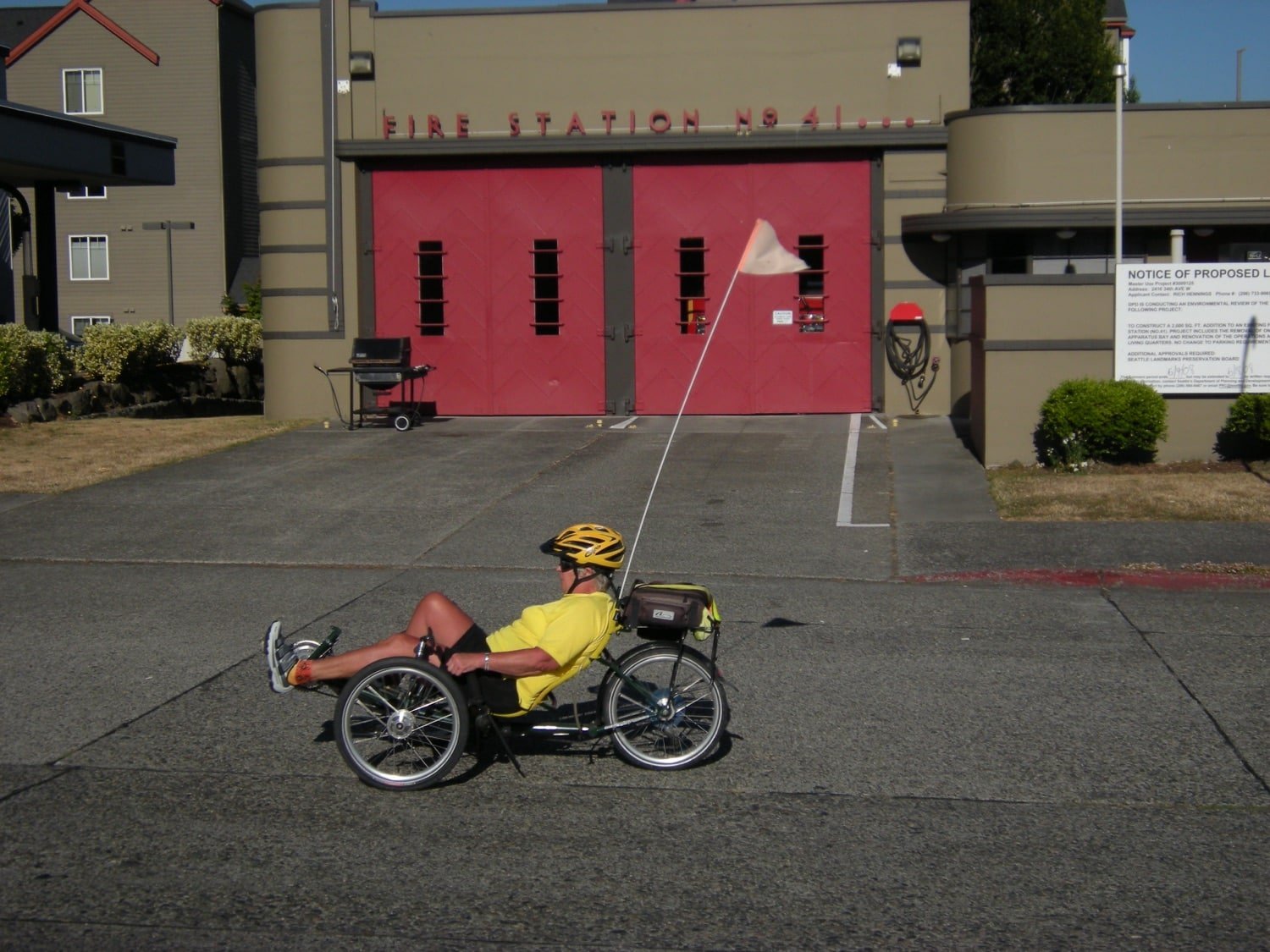
Why this is a channel story: you need shops
A rebate redeemed at a register requires a register. A fitting requires a fitter. Neither happens on a marketplace listing or a direct-to-consumer checkout.
This is the quiet structural fact of the US adaptive segment, and it runs against the grain of how the broader e-bike market has developed, where direct-to-consumer channels carry a very large share of volume. For the subsidised and adaptive portion of the senior trike category, direct-to-consumer is not the efficient channel. It is the ineligible one.
The implication is concrete. If you want access to the subsidised segment — and to the adaptive-retail buyer generally, who wants to sit on the product before buying — the dealer relationships have to exist before the programme round opens, because approval windows are short and enrolment as a participating retailer is not instant. Building that network is a twelve-month job, not a quarter.
It also changes what your product needs to carry. A dealer enrolled in a rebate programme has to substantiate what they sell: certification documentation, class labelling, specifications in the format the administering agency expects. Supplying that pack properly is a small piece of work that removes a recurring source of friction — and most suppliers do it badly or not at all.
How to treat incentives in your plan
A workable position, in four parts:
- Model the business without rebates. If the unit economics only work with a voucher attached, you do not have a business case. California demonstrated why.
- Design to the requirements anyway. Certification, classification and documentation are required by state law and increasingly by retail partners regardless of any rebate. Meeting them costs the same whether or not a programme is funded, and it makes you eligible the moment one is.
- Build the dealer network for the fitting, not the rebate. The postural buyer wants to sit on the product; the rebate rules happen to require the same physical presence. One investment, two returns.
- Track programmes at state level, not federal. No federal purchase credit exists — proposed legislation has repeatedly failed to become law — so the activity is state, city and utility programmes, and they change on legislative and budget cycles. Assign the tracking to someone, or accept that you will find out late.
What a qualifying trike actually needs
Everything above resolves to a short specification: a certified electrical system and battery, a configuration that holds the federal classification envelope, documentation a dealer can file, and a seating design that makes the fitting appointment worth attending.
If you’re choosing a trike rather than building one, the practical side matters just as much: which models qualify, what certification documents you should see, and how to buy through a participating shop. Our guide to the best three-wheel cargo bikes covers the models worth comparing, and the e-bike class labels explainer shows why the classification envelope decides eligibility.
Frequently asked questions
Is there a federal tax credit for electric trikes in the US?
No. Proposed federal legislation has repeatedly failed to pass, so incentives are state, city and utility programmes only.
Do state e-bike rebates cover three-wheeled and adaptive cycles?
Several do explicitly. Washington’s WE-Bike programme names adaptive cycles as eligible, and Boston’s programme covers adaptive e-bikes with a pre-fitting requirement. Eligibility is programme-specific, and conditions typically include recognised safety certification and standard class and power limits.
What happened to California’s e-bike voucher programme?
It ended. The Air Resources Board cancelled the anticipated third round and reallocated the remaining budget to a vehicle programme, citing state budget constraints. Roughly 2,100–2,300 vouchers were issued in total, against more than 100,000 applicants in the first round alone.
Can I buy a rebate-eligible trike direct-to-consumer?
Generally no. Rebates are typically redeemed at participating retailers with a physical location, and adaptive purchases may require a fitting appointment. The subsidised segment is reachable through dealers, not through a direct checkout.
Should my decision to buy or stock trikes depend on incentives?
No. Treat any rebate as a bonus. The durable reasons to buy a trike are the ones that exist without a subsidy — stability, comfort and the ability to keep riding.
References
- WSDOT — WE-Bike e-bike rebate programme
- City of Boston — E-Bikes incentive programme
- California Air Resources Board — California E-Bike Incentive Project
- United Mobility — State E-Bike Incentives for Electric Trikes: Read the Rules
- United Mobility — UL 2849 for Electric Trikes: What US Entry Actually Requires