
 EN
EN  DE
DE  NL
NL  IT
IT  FR
FR  ES
ES  PT
PT  DA
DA  SV
SV  FI
FI  CS
CS  EL
EL  HU
HU  ET
ET  BG
BG  PL
PL  JA
JA  KO
KO 
Electric trikes tip over for a simple reason: geometry. A three-wheeler is bought to remove the risk of falling, but a badly designed one introduces a different risk — lifting a wheel and rolling in a turn. Read owner reviews across the category and you will see it reported often enough to count as a design problem, not bad luck.
The good news is that electric trike stability is predictable from a few numbers, which means tip-over is preventable before a single unit is built. This guide covers the physics, the ratio that predicts it, and what to ask a manufacturer before you buy.
Why a trike rolls when a bicycle doesn’t
A bicycle doesn’t roll over in the trike sense — it falls sideways, and the rider stops that by balancing. A trike removes the balancing task, which is the whole point for a rider with reduced balance confidence. But in removing it, the trike takes on a car’s failure mode: with three fixed contact points, cornering force can lift the inside wheel and tip the vehicle over its outer edge.
Think of it as a contest between two forces acting through the centre of gravity: cornering pushes sideways and tries to rotate the trike around the line between its outer wheels, while gravity pulls down and resists. Whether it rolls comes down to one piece of geometry — how high the centre of gravity sits above the ground against how far it sits inboard of the outer wheels.
This is not a bicycle problem and bicycle intuition will not solve it; vehicle safety has a standard measure for it.
The one number that predicts tip-over
Vehicle engineers call it the Static Stability Factor (SSF), and the US National Highway Traffic Safety Administration defines it as track width divided by twice the centre-of-gravity height — T/2H. Read simply, it is the cornering force, in g, that the vehicle can survive before it begins to tip. Higher means safer.
For context from the car world: passenger cars typically sit between roughly 1.3 and 1.5, and taller SUVs between roughly 1.0 and 1.3 — and the difference in real-world rollover rates between those bands is large. The number is driven by exactly two things a designer controls: a wider track or a lower centre of gravity. Both raise the SSF. Everything else in stability engineering is in service of moving those two variables.
Trike research agrees. Design analyses converge on a plain rule of thumb: keep the centre of gravity below half the track width; a non-tilting three-wheeler only approaches four-wheeler rollover resistance when the centre of gravity is low and close to the paired wheels. This is why a stability claim that cannot be expressed as geometry is just decoration.
Where the rider’s weight sits — and why seat height is a safety decision
Here is where seating design stops being a comfort decision and becomes a safety one.
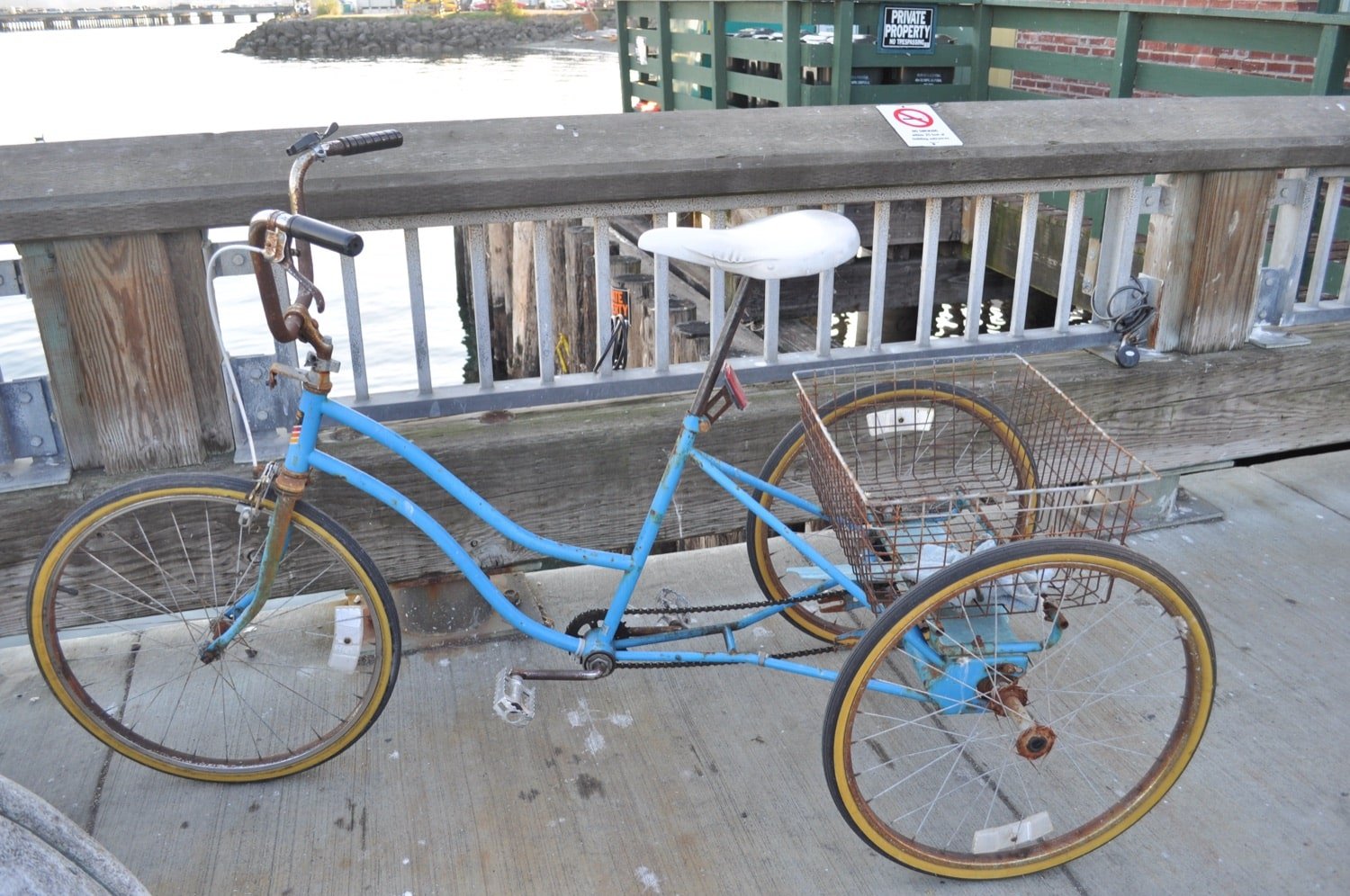
On an upright trike, the rider sits high, and the rider is most of the mass. A tall seat pushes the combined centre of gravity up, shrinking the SSF and bringing the tip-over threshold down into the range of ordinary riding — a brisk turn, a camber change, a swerve.
On a semi-recumbent platform, the rider sits low and reclined, placing that same mass much closer to the ground. The rider is positioned in the vehicle rather than on it, which is the single most effective lever a designer has on centre-of-gravity height, because the rider is the largest movable mass in the system.
That is the structural safety argument for the format, sitting underneath the comfort argument rather than beside it: the same reclined geometry that supports the back also lowers the centre of gravity. Comfort and stability are the same design decision.
Tadpole or delta? What the wheel layout changes
Wheel layout interacts with all of this. A tadpole — two wheels at the front, one at the rear — places the paired stabilising wheels ahead of the rider and generally corners with more composure, because the rider’s mass sits inside a supportive triangle under braking and turning. A delta — one front wheel, two rear — is more familiar and easier to step into, but the single steered front wheel is more prone to unwanted oversteer at speed.
Neither layout is a substitute for the centre-of-gravity-to-track ratio; the ratio dominates, and a good delta beats a bad tadpole. For a low-speed senior platform, the delta’s easy step-through entry is a genuine advantage, and its oversteer tendency rarely surfaces at the speeds this category rides — provided the ratio is correct.
The dangerous moment: braking while turning
Static geometry describes a trike standing still. Riders are not standing still, and the dangerous moment is a combination, not a single input.
The tip-over in real complaints is rarely a steady corner taken too fast; it is braking while turning — arriving at a junction, grabbing the brakes mid-corner, hitting a pothole in a bend. Braking shifts load forward, and in a turn that combines with the sideways cornering force to push the trike toward its tipping line. For a senior rider, who is more likely to brake late and hard precisely because reactions have slowed, this is not an edge case. It is Tuesday.
Two design responses follow, and both are decided before the product exists:
- Brake balance and modulation. Grabby, all-or-nothing braking provokes exactly the forward-and-sideways load transfer that tips a trike. Progressive, balanced braking — and, on heavier electric platforms, hydraulic discs rather than marginal mechanical ones — is a stability feature, not a luxury. The mechanical-disc complaints in owner feedback are describing this failure. Our guide to regenerative braking on e-bikes explains the wider braking picture on electric bikes.
- Start-speed and assist limiting. A gentle, rate-limited pull-away rather than an abrupt throttle surge keeps the trike inside its stable envelope at the two moments it is most vulnerable: setting off and manoeuvring at low speed. This is a controller decision, made in firmware, specified at design.
Designing for a rider who can’t save themselves
Every stability system in a car assumes a driver who reacts. Every stability decision in a senior trike should assume a rider who does not — or cannot in time. That is the assumption separating a trike engineered for this market from a general-purpose trike sold into it.
It changes the brief in concrete ways: the trike must be stable without corrective weight-shifting, tolerate a misjudged entry speed, and brake predictably from a hard, late input — because those are the inputs it will get. And it must do all of this fully loaded, with shopping, a heavier rider and a camber, because the margins that matter are the ones that survive real use.
If you’re choosing between models for yourself or a family member, our guide to the best e-bikes for seniors includes the practical buying criteria this category needs.
What to ask a manufacturer (numbers, not adjectives)
The electric trike stability conversation should be specific — vague reassurance is the warning sign. Useful questions:
- What is the track width, and what is the estimated centre-of-gravity height with a rider aboard?
- Does the design keep the centre of gravity below half the track, loaded?
- Tadpole or delta — and why that choice for this use case?
- What is the braking system, and how does it behave under combined braking and turning?
- Is there start-speed or assist rate limiting in the controller?
- Has the platform been validated for stability by test, loaded — not just calculated?
- Can the factory adjust track, seat height and drive behaviour to the intended rider weight and terrain, or is it fixed catalogue geometry?
A manufacturer that answers in numbers is engineering for the use case. One that answers in adjectives is selling you a general-purpose trike and hoping. If you’re comparing complete bikes rather than dealing with a factory, our three-wheel cargo bike guide shows what good geometry looks like in practice.
Frequently asked questions
Why do electric trikes tip over?
Because a rigid three-wheel base takes on a car’s rollover failure mode: in a turn, sideways force through a high centre of gravity can lift the inside wheel. It is governed by track width versus centre-of-gravity height, and is most likely when braking and turning combine.
What makes one electric trike more stable than another?
Primarily the ratio of track width to centre-of-gravity height, expressed as the Static Stability Factor (T/2H). A wider track and a lower centre of gravity both raise it. Seat height matters enormously because the rider is the largest movable mass; a low, reclined seat lowers the centre of gravity and raises stability.
Are semi-recumbent trikes more stable than upright ones?
Structurally, yes — the low seated position places the rider’s mass closer to the ground, lowering the combined centre of gravity and improving rollover resistance. Wheel layout and track width still matter and must be designed correctly regardless.
Is a tadpole or a delta trike safer?
Tadpole layouts (two wheels at the front) generally corner with more composure and place the rider’s mass inside a supportive triangle under braking. Delta layouts (two wheels at the rear) are easier to step into but more prone to oversteer at speed. Neither overrides the centre-of-gravity-to-track ratio, which is the dominant factor — a well-designed delta outperforms a poorly designed tadpole.
What should I ask a manufacturer about stability?
Ask for numbers: track width, estimated loaded centre-of-gravity height, whether the design keeps the centre of gravity below half the track when loaded, the braking system’s behaviour under combined braking and turning, whether the controller limits start speed, and whether stability has been validated by loaded testing rather than calculation alone.
References
- NHTSA — Rollover resistance rating methodology (Static Stability Factor)
- IRJET — Tricycle design analysis: stability and centre-of-gravity
- JETIR — Three-wheel vehicle dynamics under braking and turning
- United Mobility — Electric Trike Stability Engineering: Designing Out Tip-Over
- United Mobility — Semi-Recumbent vs Upright Electric Trike: Building a US Range