
 DA
DA  EN
EN  DE
DE  NL
NL  IT
IT  FR
FR  ES
ES  PT
PT  SV
SV  FI
FI  CS
CS  EL
EL  HU
HU  ET
ET  BG
BG  PL
PL  JA
JA  KO
KO Hvis du vælger en lastcykelkasse udelukkende efter udseende, betaler du som regel for fejlen senere i stabilitet, adgang til lasten, vejrbeskyttelse, serviceomkostninger eller brugerfrustration. En familiekasse, der er perfekt til skolekørsel, kan have den forkerte form til pakkeleveringer. En stor leveringskasse, der ser effektiv ud på papiret, kan bremse hvert stop, hvis låget, døren eller hyldeopsætningen er forkert.
Det problem bliver dyrere, når cyklen bliver en del af en forretningsarbejdsgang. En dagligvareoperatør kan miste kølekædekonsistens, fordi kassens isolering er for let. En kommunal flåde kan kæmpe med værktøjsorganisering, fordi rummene aldrig blev designet omkring teknikerens rute. En OEM-køber kan specificere det forkerte materiale og ende med unødvendig vægt, dårlig holdbarhed eller en kasse, der er sværere at fremstille i stor skala.
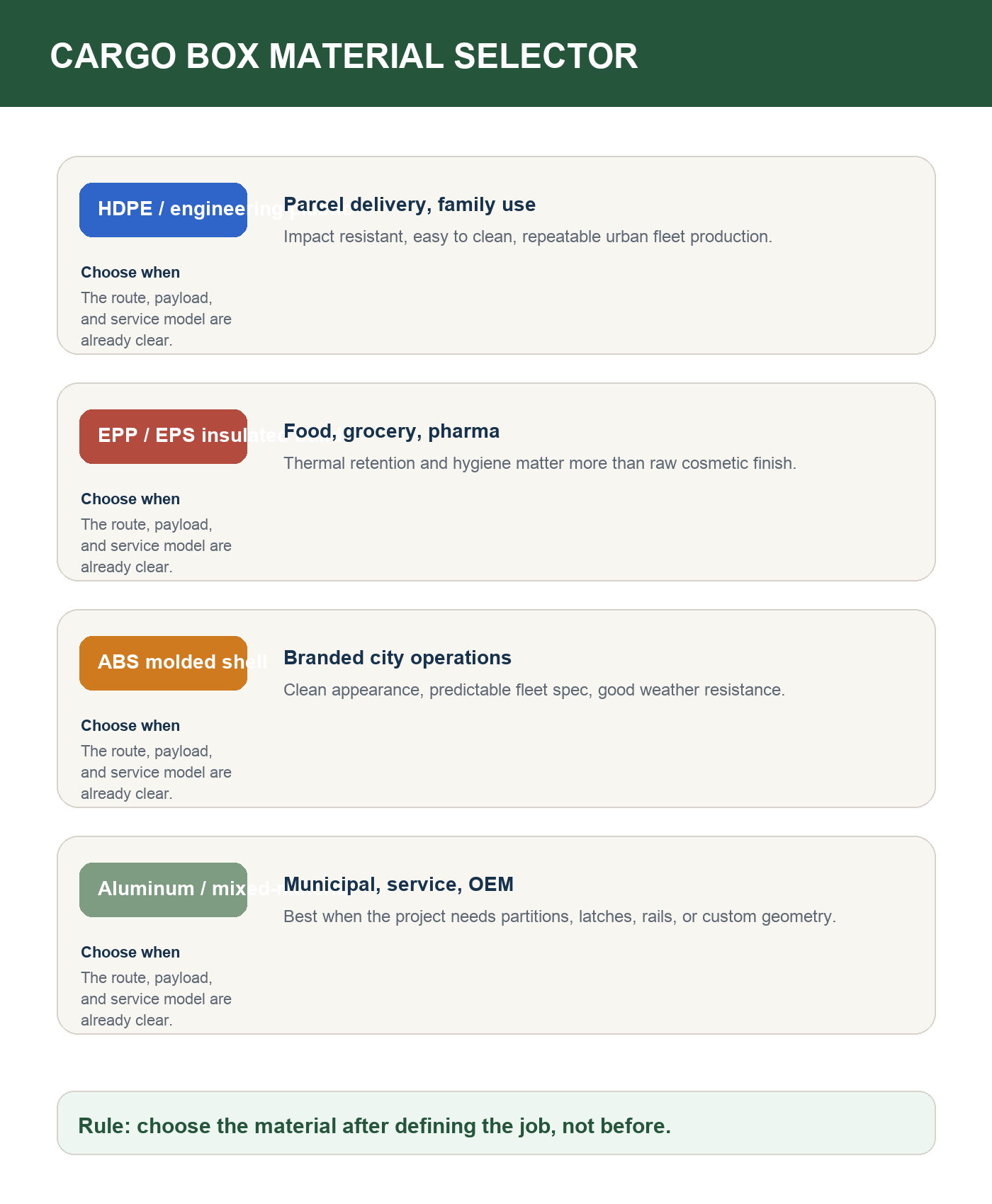
Det korte svar er dette: vælg lastcykelkassen baglæns fra jobbet. Start med lasttype, stopfrekvens, vejrpåvirkning, nødvendigt indre volumen og læsningsmetode. Match derefter disse krav til det rigtige kassemateriale, dimensioner, låg- eller dørlayout, isoleringsniveau, brandingmetode og monteringsgrænseflade. I de fleste reelle projekter fungerer HDPE eller støbt plast godt til højforbrugs bylevering og familiebrug, isolerede kompositstrukturer passer til fødevare- og farmaceutisk logistik, og aluminium eller blandede materialer giver mening, når købere har brug for mere tilpasset geometri, reolsystemer eller industriel holdbarhed.
Hvorfor specifikation af lastkassen betyder noget
På en normal cykel er opbevaring normalt en tilbehørsbeslutning. På en lastcykel er kassen en del af produktsystemet.
Det påvirker:
- beskyttelse af lasten
- rytterens synlighed og håndtering
- stop-og-kør-effektivitet
- cyklens samlede bredde og sikkert sving
- vedligeholdelseskompleksitet
- brandpræsentation
- rutens økonomi
Regen's egen guide til lastcyklens lastekapacitet forklarer, hvorfor rammestyrke og lasttal betyder noget, men kassen afgør, om den teoretiske kapacitet er kommercielt nyttig. Regen's side om kassemateriale og klistermærketilpasning viser også, hvorfor købere ofte har brug for kassevalg ud over en standardhylde fra hylden.
Den største specifikationsfejl er at behandle “større” som “bedre”. En større kasse kan øge frontarealet, øge egenvægten, reducere manøvredygtigheden i tæt trafik og friste operatører til at overbelaste cyklen. Det korrekte mål er brugbart volumen, ikke maksimalt volumen.
De vigtigste materialer til lastkasser og hvor de passer bedst
Materialevalg bør komme efter driftskrav, men det former stadig hele projektet, fordi det ændrer vægt, vejrbestandighed, fremstillingsevne, branding og reparationslogik.
HDPE og andre tekniske plasttyper
Højdensitetspolyethylen og relaterede tekniske plasttyper er almindelige i lastcykelkasser, fordi de balancerer slagfasthed, vejrtolerance og produktionskonsistens. Regen tilbyder specifikt lastkasser i HDPE, EPS, EPP, ABS og aluminium afhængigt af projektet.
Hvorfor købere vælger denne kategori:
- god slagfasthed til daglig bybrug
- let rengørlige overflader
- lav korrosionsrisiko
- egnet til støbt eller termoformet serieproduktion
- praktisk base for brandingfolie eller klistermærker
Denne type kasse giver ofte mest mening til pakkelevering, familletransport og gentagen byflådebrug, hvor operatøren ønsker holdbarhed uden fabrikationskompleksiteten ved en fuldt tilpasset metalindkapsling.
EPP, EPS og isolerede kompositstrukturer
Ekspanderet polypropylen og ekspanderet polystyren er mere relevante, når isolering, let konstruktion eller intern temperaturstabilitet betyder noget. Kølekædeoperatører bruger ofte isolerede strukturer frem for en almindelig skal, fordi kassen skal bevare produktets tilstand, ikke bare bære volumen.
For eksempel beskriver Cold & Co en lastcykelleveringskasse med 880 liters volumen, omkring 33 kg kassevægt og påstået temperaturretention i op til 72 timer afhængigt af konfigurationen. Det er en helt anden designlogik end en familie- eller parcelkasse. Her betyder isoleringsydelse, indvendig foring og dørtætningskvalitet mere end kosmetik.
Denne klasse passer til:
- dagligvare- og måltidslevering
- farmaceutisk last-mile-distribution
- laboratorieprøvetransport
- enhver rute, hvor temperaturstabilitet er en del af servicegarantien
ABS og støbte urbane nyttekasser
ABS vælges ofte, når køberen ønsker et rent støbt udseende, repeterbarhed og anstændig slagadfærd i daglig brug. Bluemooov fremhæver ABS-kasser delvist, fordi de tilbyder en god styrke-til-vægt-balance og vejrbestandighed til professionelle leveringscykler.
ABS-baserede designs fungerer normalt godt, når prioriteterne er:
- konsistent produktionsudseende
- urban kommerciel branding
- moderat tilpasning uden fuld skræddersyet metalfabrikation
- forudsigelig vedligeholdelse for en flåde
Aluminium og blandede materialer
Aluminium betyder noget, når geometrien er mere tilpasset, eller når køberen har brug for hylder, skillevægge, låse, forstærkede monteringspunkter eller industrielt udseende nyttefunktioner. Det er især nyttigt i B2B- og kommunale projekter, hvor kassen er en del af et arbejdskøretøj, ikke bare forbrugeropbevaring.
Afvejningen er, at aluminiumsløsninger normalt handler mindre om billig masseproduktion og mere om skræddersyede layouts, hardwareintegration og strukturel nytte. De kan også være lettere at modificere til låsbare døre, reolsystemer, værktøjsrum eller blandede servicemoduler.
Denne klasse passer til:
- kommunale vedligeholdelsesflåder
- serviceteknikere
- industrielle campusser
- white-label- og ODM-projekter med unikke geometrikrav
Sådan størrelsesbestemmer du kassen korrekt
Den rigtige kassestørrelse starter med rute-logik, ikke kun liter.
En praktisk størrelsesbestemmelsesmetode er:
- Definér den faktiske lasteenhed: børn, pakker, måltidsposer, indkøbsposer, værktøj eller medicinkasser.
- Mål de faktiske ydre dimensioner af disse lasteenheder, inklusive stablingstolerance.
- Tilføj kun den adgangsplads, der er nødvendig for lastningshastighed og håndbevægelser.
- Kontrollér, om den resulterende bredde og højde stadig matcher rytterens selvtillid, lovmæssige breddeforventninger og rutehindringer.
- Sammenlign volumen med cyklens faktiske lasteevne og akselbelastningsgrænser.
Dette lyder grundlæggende, men det forhindrer to almindelige fejl:
- at gøre kassen for stor og skade håndteringen
- at gøre kassen for lille og tvinge ineffektive pakkemønstre
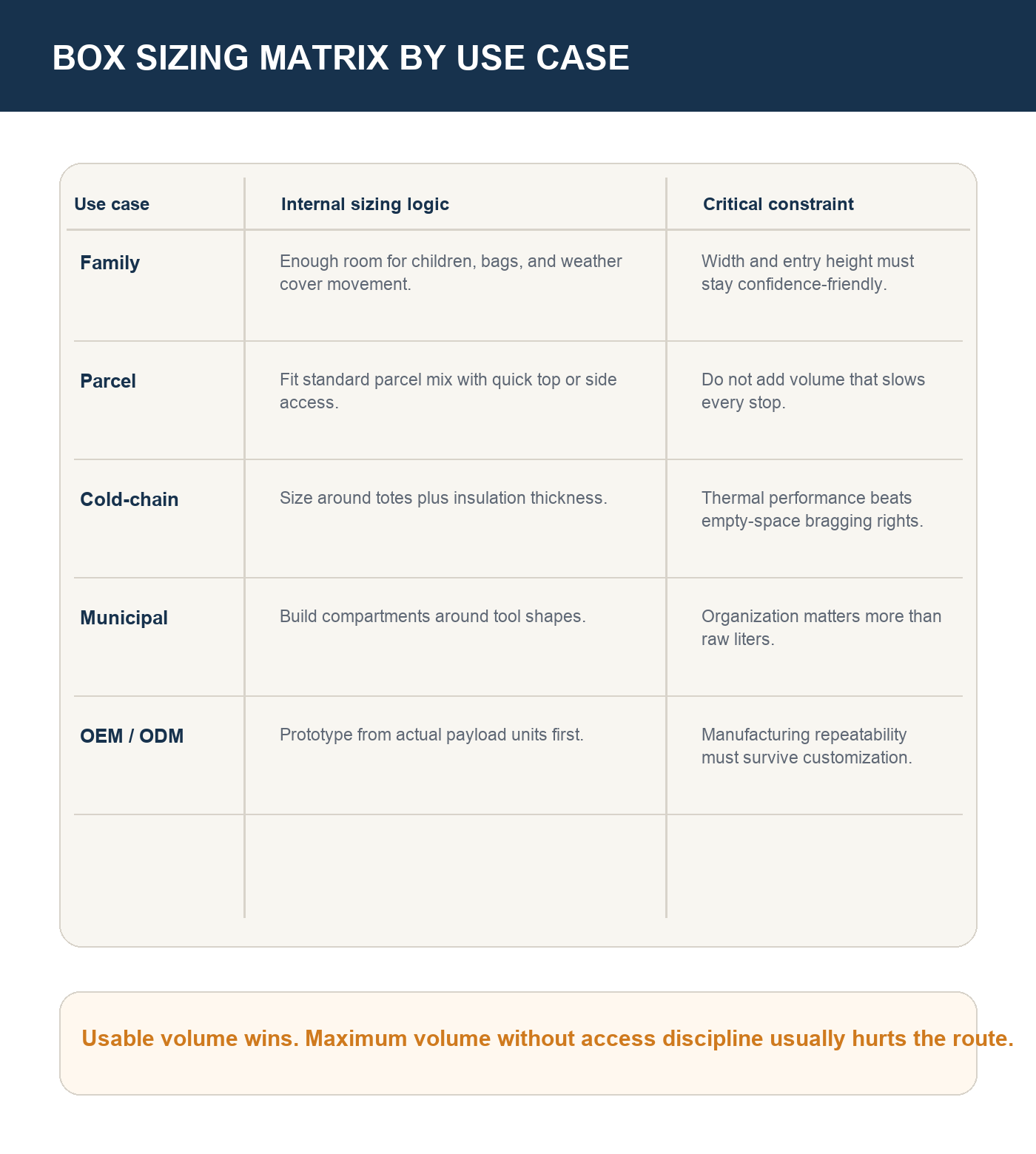
Urban Arrow bemærker, at Family-frontkassen er cirka 86 cm lang, 68 cm bred og 50 cm høj, hvilket er nok til at vise, hvordan forbrugerfamiliekasser normalt er designet omkring håndterbare bydimensioner snarere end industrielt volumen. Derimod beskriver Urban Freight Labs forskning i modulær cykellogistik udskiftelige containere på omkring 95 kubikfod og cirka 400 punds lastkapacitet til specifikke fragtanvendelser. Det er ikke udskiftelige produktkategorier, selvom begge er “lastkasser.”
En simpel størrelsesbestemmelsesramme efter anvendelsestilfælde
| Use case | Praktisk størrelseslogik | Hvad betyder mest |
|---|---|---|
| Familietransport | Moderat bredde, sikker siddeplads, kompatibilitet med vejrbeskyttelse | rytterens synlighed, børnekomfort, ind- og udstigning |
| Pakkelevering | Maksimal brugbar kubik inden for stabile håndteringsgrænser | stop-effektivitet, stabling, låsbarhed |
| Mad / kølekæde | Intern totetilpasning plus isoleringstykkelse | termisk fastholdelse, hygiejne, forsegling |
| Kommunal / service | Opdelt geometri frem for rå liter | værktøjsadgang, skillevægge, serviceholdbarhed |
| OEM / ODM-customprojekt | Størrelse defineret af lasteenhed og produktionsgentagelighed | fremstillelighed, monteringsstandard, branding |
Hvad brugerdefineret konfiguration faktisk betyder
Mange købere siger, at de har brug for en “brugerdefineret lastkasse,” men tilpasning kan betyde meget forskellige ting. Det hjælper at adskille kosmetiske ændringer fra operationelle ændringer.
Kosmetisk tilpasning
- farvetilpasning
- logo-klistermærker eller wraps
- overfladegrafik
- branded regnslag eller låg
Disse ændringer betyder noget for brandidentitet, men de ændrer ikke kassens arbejdsgangspræstation.
Funktionel tilpasning
- frontåbnings- eller sideåbningsdøre
- top-låg eller delte låg
- isoleret indvendig foring
- aftagelige hylder eller skillevægge
- låsesystemer
- drænegenskaber
- udskæringer til oplader eller batteriadgang
- børnesæder og sele-interfaces
- modulære monteringspunkter
Dette er laget, der ændrer, hvor hurtigt rytteren kan læsse, aflæsse, rengøre, sikre eller omkonfigurere køretøjet. Regen’s funktionel konfigurationstilpasningsside er relevant her, fordi det indrammer ladcyklen som et system bygget op omkring nyttelast, rute og operatørkrav snarere end en generisk ramme med en kasse monteret.
Hvilken indvirkning kassen har på slutbrugere
Kassen ændrer brugeroplevelsen, selv når motoren, rammen og bremserne forbliver de samme.
For familieryttere
Kassen bestemmer, hvor nemt det er at løfte børn ind, spænde dem sikkert fast, tilføje vejrbeskyttelse og holde daglige ting organiserede. Skarpe vægge, uhensigtsmæssig indstigningshøjde eller dårlig integration af regncover kan få en cykel til at føles mindre brugbar længe før, rytteren når motorens grænser.
For leveringsryttere
Kassen påvirker hvert stop. Hvis ryttere skal bøje akavet, grave gennem stablede pakker eller kæmpe med et langsomt låsesystem, falder ruteydeevnen, selv når cyklen er mekanisk i orden. Kasseform og adgangsmønster påvirker direkte leveringer pr. time.
For flådeledere
Kassen påvirker rengøringstid, skadesprocenter, udskiftningsomkostninger og ruteegnethed. En veldesignet standardkasse forenkler også træning, fordi alle ryttere interagerer med samme læsselogik.
For OEM- og private-label-købere
Kassen bliver en del af produkt-marked-tilpasningen. En familieorienteret cykel med en industriel oversized kasse sender det forkerte signal. En kommerciel flådecykel uden lockable eller compartment-ready mulighed kan misse operatørens faktiske arbejdsgang.
Virkelighedsnær konfigurationslogik efter branche
Det er her, valget bliver kommercielt brugbart.
Familiemobilitet
Recommended logic:
- kasse med moderat bredde
- holdbart plast- eller mixed-material-skal
- kompatibilitet med barnesæde
- understøttelse af vejrcover
- afrundede kanter og nem indstigningshøjde
Målet er tryghed, komfort og vejrmæssig praktisk anvendelighed, ikke maksimalt kubikvolumen.
Pakke- og last-mile-levering
Recommended logic:
- stor kubisk kasse med effektiv top- eller sideadgang
- holdbart støbt plast- eller HDPE-skal
- låsemulighed
- intern layout, der matcher pakkestørrelser
- udvendige overflader egnet til branding
Prioriteten er hurtige gentagne stop med forudsigelig læsselogik. Hvis branding betyder noget, betyder rene flade overflader og repeterbar wrap-kvalitet mere end premium-finish.
Dagligvare-, fødevare- og farmaceutisk distribution
Recommended logic:
- isoleret struktur
- vaskbart indre
- forseglet åbningssystem
- internt volumen baseret på tote-mål, ikke rå tom plads
- temperaturkontrolstrategi tilpasset rutevarighed
Det er den branche, hvor isoleringstykkelse, hygiejne og termisk ydeevne retfærdiggør ekstra kompleksitet. En kasse, der blot “passer” til varerne, er ikke nok, hvis temperaturdrift bryder servicemodellen.
Kommunale og vedligeholdelsesflåder
Recommended logic:
- aluminium- eller mixed-material-utility-kasse
- skillevægge og aflåselige rum
- hardware-monteringspunkter
- nem rengøring og adgang til feltreparation
- dimensioner matchet til værktøj og reservedele
Disse købere har normalt brug for et arbejdskøretøj, ikke en forbrugerladcykel. Det bedste design ligner ofte mere et kompakt mobilt servicemodul end en indkøbskasse.
OEM / ODM og white-label-programmer
Recommended logic:
- vælg materiale baseret på produktionsskala og tilpasningsdybde
- standardiser monteringsinterfaces tidligt
- test adgangslayouts før godkendelse af værktøj
- tilpas kassedimensioner til målmarkedets reelle nyttelastmønster
- adskil marketingtilpasning fra strukturel tilpasning
Det er derfor, mange B2B-købere bør prototype med faktiske nyttelastenheder, før de færdiggør kassen. At rette en læssefejl efter værktøj eller produktionsopsætning er meget dyrere end at forfine geometrien på forhånd.
Sådan implementerer du en bedre arbejdsgang for box-spec
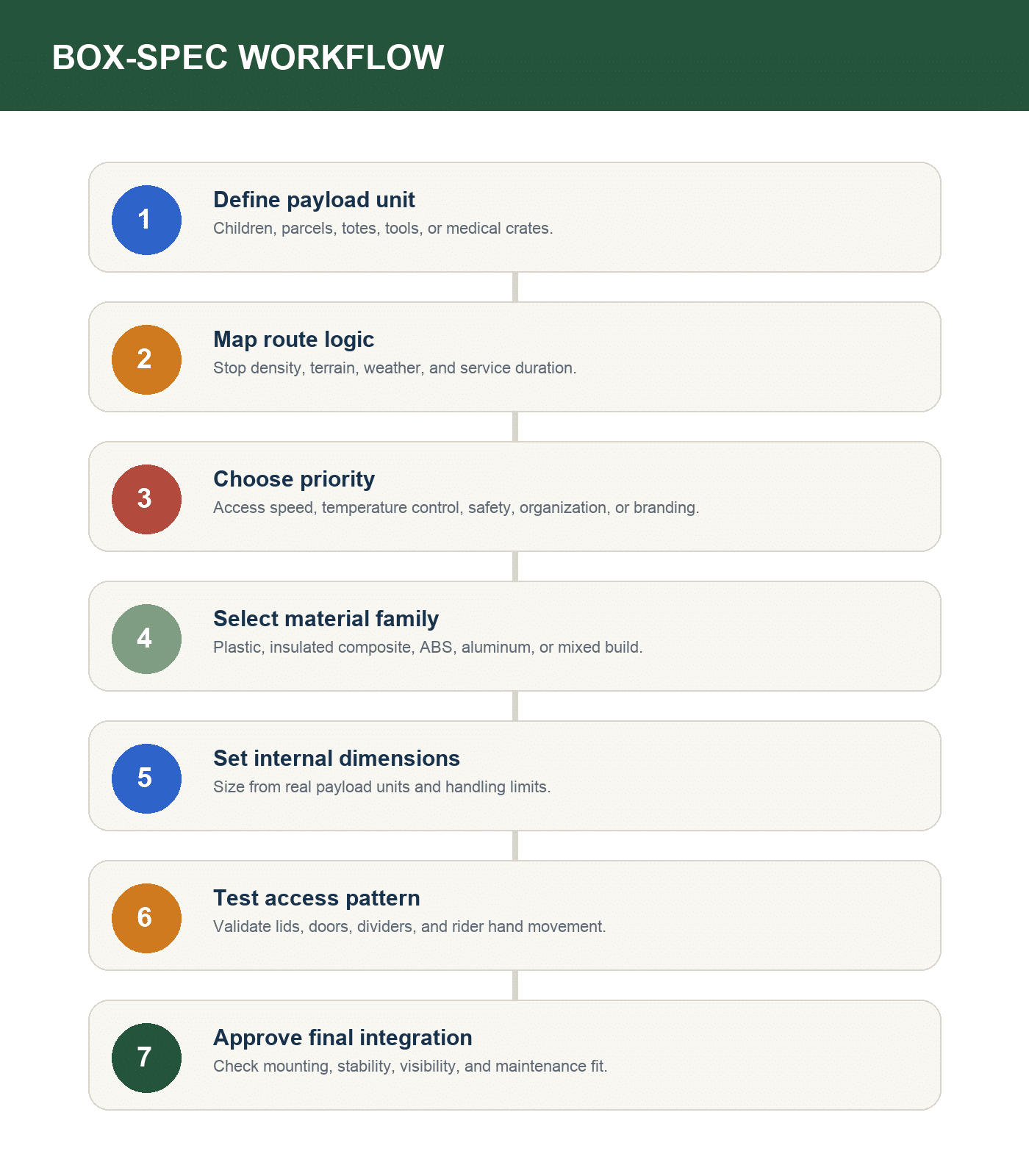
Hvis du specificerer en ladcykelbox til et nyt produkt eller en flåde, skal du bruge en beslutningssekvens som denne:
- Liste over de nyttelastenheder, boxen skal bære på en normal dag.
- Ranger ruteforholdene: flad byzone, blandet terræn, kølekæde, høj stopdensitet, familietransport eller servicearbejde.
- Beslut om den kritiske faktor er adgangshastighed, temperaturkontrol, børnesikkerhed, modulær organisering eller brandudseende.
- Vælg den basismaterialefamilie, der passer bedst til den prioritet.
- Definer interne mål ud fra nyttelastenheder og håndteringsgrænser, ikke ud fra en konkurrents box.
- Test dør-, låg- og skillekoncepter mod reel lastningsadfærd.
- Bekræft, at boxen stadig understøtter cyklens stabilitet, førerens synlighed og vedligeholdelsesplan.
Den implementeringsdisciplin er det, der gør boxen fra et kosmetisk tilbehør til et driftsaktiv.
Praktiske udvælgelsesfejl, der skal undgås
- at vælge boxen før definering af nyttelastenheden
- at kopiere en familiecykelbox til en kommerciel leveringsarbejdsgang
- at behandle isolering som valgfrit, når temperaturkonsistens er en del af servicen
- at ignorere førerens adgangstid ved hvert stop
- at overvurdere råvolumen og undervurdere håndtering
- at godkende brugerdefineret geometri før test af reel pakningsadfærd
Den mest nyttige måde at tænke på ladcykelboxe
Boxen er grænsefladen mellem ladcyklen og det job, den skal udføre. Materialer bestemmer holdbarhed og fremstillingsegnethed. Størrelse bestemmer håndtering og nyttelastpasning. Konfiguration bestemmer arbejdsgangshastighed og brugertilfredshed.
Når købere starter fra disse tre lag i stedet for kun fra udseende, træffer de bedre beslutninger. Det gælder, uanset om cyklen transporterer børn gennem byen, pakker gennem et bycentrum, kølede dagligvarer til lejligheder eller værktøj gennem en kommunal servicerute.
Referencer
- Regen, Materiale og sticker-tilpasning til ladcykelbox
- Regen, Tilpasning af funktionelt konfigurationssystem til ladcykel
- Regen, 10 nøglefaktorer, der påvirker ladcyklens lastekapacitet
- Urban Arrow Servicecenter, Hvor stor er boxen på Urban Arrow Family?
- Urban Freight Lab, Cykellogistik-mikrohubs og overførbare containere
- Cold & Co, Isoleret leveringsbox til ladcykel
- Bluemooov, Oversigt over ladcykler og ladcykelboxe