
 DE
DE  EN
EN  NL
NL  IT
IT  FR
FR  ES
ES  PT
PT  DA
DA  SV
SV  FI
FI  CS
CS  EL
EL  HU
HU  ET
ET  BG
BG  PL
PL  JA
JA  KO
KO Wenn Sie eine Cargo-Bike-Box nur nach dem Aussehen auswählen, zahlen Sie später meist für den Fehler in Stabilität, Zugang zur Nutzlast, Witterungsschutz, Servicekosten oder Nutzerfrustration. Eine Familienbox, die perfekt für Schulwege ist, kann die falsche Form für Paketzustellungen haben. Eine große Lieferbox, die auf dem Papier effizient aussieht, kann jeden Stopp verlangsamen, wenn Deckel, Tür oder Regalaufteilung falsch sind.
Dieses Problem wird teurer, sobald das Bike Teil eines Geschäftsablaufs wird. Ein Lebensmittelhändler kann die Kühlkettenkonsistenz verlieren, weil die Boxisolierung zu leicht ist. Eine kommunale Flotte kann mit der Werkzeugorganisation kämpfen, weil die Fächer nie um die Route des Technikers herum entworfen wurden. Ein OEM-Einkäufer kann das falsche Material spezifizieren und am Ende unnötiges Gewicht, schlechte Haltbarkeit oder eine Box erhalten, die sich in großem Maßstab schwerer fertigen lässt.
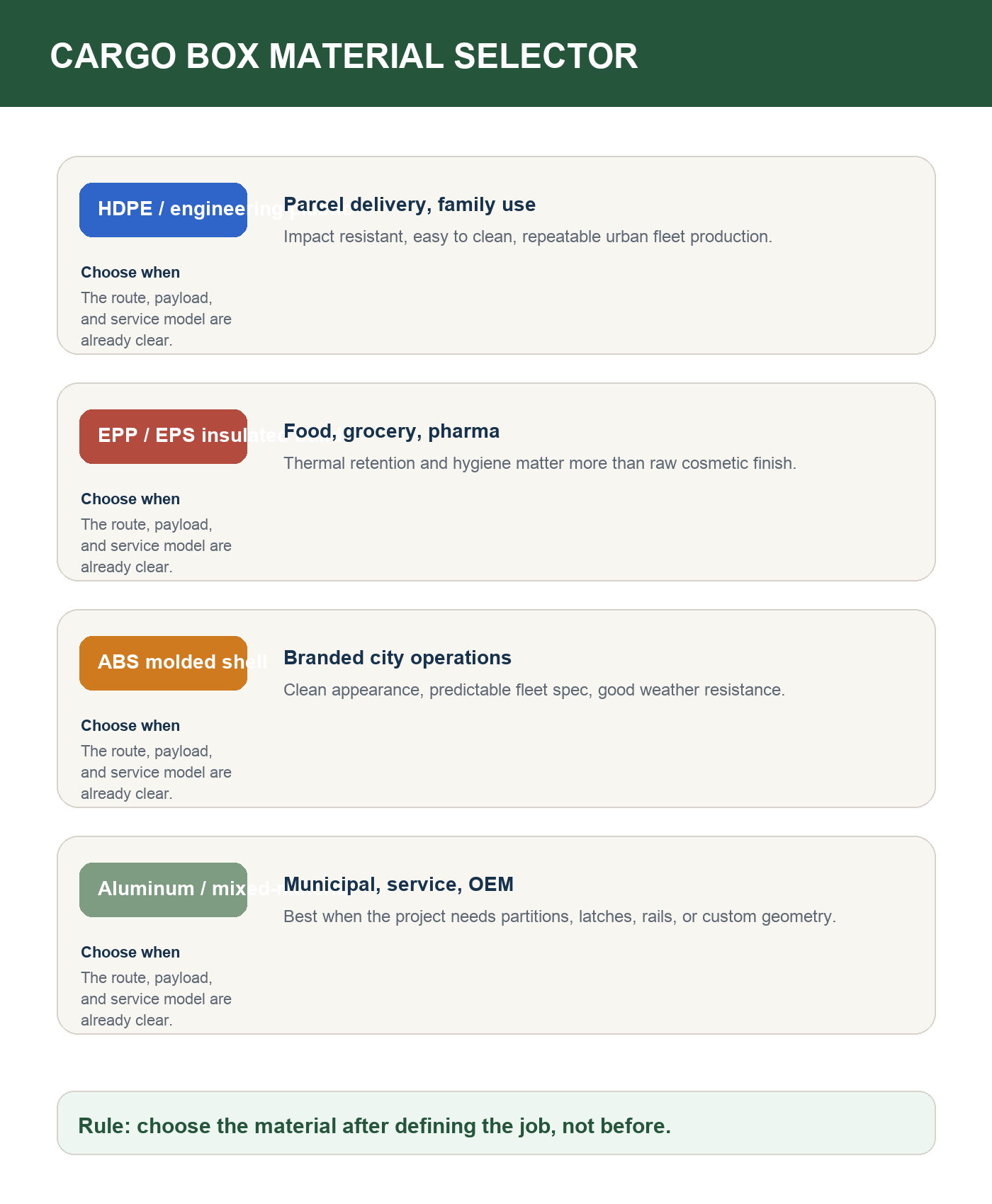
Die kurze Antwort lautet: Wählen Sie die Cargo-Bike-Box vom Job rückwärts. Beginnen Sie mit Nutzlasttyp, Stoppfrequenz, Witterungseinfluss, erforderlichem Innenvolumen und Lademethode. Passen Sie diese Anforderungen dann an das richtige Boxmaterial, die Abmessungen, das Deckel- oder Türlayout, den Isolierungsgrad, die Branding-Methode und die Montageschnittstelle an. In den meisten realen Projekten funktionieren HDPE oder geformter Kunststoff gut für urbane Lieferung mit hoher Nutzung und Familieneinsatz, isolierte Verbundstrukturen passen zur Lebensmittel- und Pharmalogistik, und Aluminium- oder Mischmaterialbauten sind sinnvoll, wenn Käufer mehr individuelle Geometrie, Racking oder industrielle Haltbarkeit benötigen.
Warum die Spezifikation der Cargo-Box wichtig ist
Bei einem normalen Fahrrad ist Stauraum normalerweise eine Zubehörentscheidung. Bei einem Cargo-Bike ist die Box Teil des Produktsystems.
Es betrifft:
- Schutz der Nutzlast
- Sichtbarkeit und Handling des Fahrers
- Stop-and-go-Effizienz
- Gesamtbreite des Bikes und Kurvenvertrauen
- Wartungskomplexität
- Markenpräsentation
- Routenökonomie
Regens eigener Leitfaden zur Ladekapazität von Cargo-Bikes erklärt, warum Rahmenstärke und Nutzlastzahlen wichtig sind, aber die Box bestimmt, ob diese theoretische Kapazität kommerziell nutzbar ist. Regens Seite zur Anpassung von Cargo-Box-Material und Aufklebern zeigt auch, warum Käufer oft Boxoptionen jenseits eines standardmäßigen Regalkorbs benötigen.
Der wichtigste Spezifikationsfehler ist, “größer” als “besser” zu behandeln. Eine größere Box kann Stirnfläche hinzufügen, das Leergewicht erhöhen, die Manövrierfähigkeit im dichten Verkehr verringern und Betreiber dazu verleiten, das Bike zu überladen. Das richtige Ziel ist nutzbares Volumen, nicht maximales Volumen.
Die wichtigsten Cargo-Box-Materialien und wo sie am besten passen
Die Materialwahl sollte nach den betrieblichen Anforderungen kommen, aber sie prägt dennoch das gesamte Projekt, weil sie Gewicht, Witterungsbeständigkeit, Fertigbarkeit, Branding und Reparaturlogik verändert.
HDPE und andere technische Kunststoffe
Hochdichtes Polyethylen und verwandte technische Kunststoffe sind bei Cargo-Bike-Boxen üblich, weil sie Schlagfestigkeit, Witterungstoleranz und Produktionskonsistenz ausbalancieren. Regen bietet je nach Projekt speziell Cargo-Boxen in HDPE, EPS, EPP, ABS und Aluminium an.
Warum Käufer diese Kategorie wählen:
- gute Schlagfestigkeit für den täglichen urbanen Einsatz
- leicht zu reinigende Oberflächen
- geringes Korrosionsrisiko
- geeignet für geformte oder warmgeformte Serienproduktion
- praktische Basis für Branding-Wraps oder Aufkleber
Diese Art von Box ist oft am sinnvollsten für Paketzustellung, Familientransport und wiederholten städtischen Flotteneinsatz, bei dem der Betreiber Haltbarkeit ohne die Fertigungskomplexität eines vollständig individuellen Metallgehäuses wünscht.
EPP, EPS und isolierte Verbundstrukturen
Expandiertes Polypropylen und expandiertes Polystyrol sind relevanter, wenn Isolierung, Leichtbauweise oder interne Temperaturstabilität wichtig sind. Kühlkettenbetreiber verwenden oft isolierte Strukturen statt einer einfachen Hülle, weil die Box den Produktzustand bewahren muss, nicht nur Volumen transportieren.
Zum Beispiel beschreibt Cold & Co eine Cargo-Bike-Lieferbox mit 880 Litern Volumen, etwa 33 kg Boxgewicht und einer angegebenen Temperaturhaltung von bis zu 72 Stunden je nach Konfiguration. Das ist eine völlig andere Designlogik als bei einer Familien- oder Paketbox. Hier sind Isolierungsleistung, Innenauskleidung und Qualität der Türdichtung wichtiger als Kosmetik.
Diese Klasse passt zu:
- Lebensmittel- und Mahlzeitenlieferung
- Pharmazeutische Last-Mile-Distribution
- Transport von Laborproben
- jede Route, bei der Temperaturstabilität Teil des Serviceversprechens ist
ABS und geformte urbane Utility-Boxen
ABS wird oft gewählt, wenn der Käufer ein sauberes geformtes Aussehen, Wiederholbarkeit und ordentliches Schlagverhalten im täglichen Einsatz wünscht. Bluemooov hebt ABS-Boxen teilweise hervor, weil sie ein gutes Verhältnis von Festigkeit zu Gewicht und Witterungsbeständigkeit für professionelle Lieferbikes bieten.
ABS-basierte Designs funktionieren normalerweise gut, wenn die Prioritäten sind:
- konsistentes Produktionsaussehen
- urbanes kommerzielles Branding
- moderate Individualisierung ohne vollständig maßgeschneiderte Metallfertigung
- vorhersehbare Wartung für eine Flotte
Aluminium- und Mischmaterialfertigung
Aluminium ist wichtig, wenn die Geometrie individueller ist oder der Käufer Regale, Trennwände, Verschlüsse, verstärkte Montagepunkte oder industriell wirkende Utility-Module benötigt. Es ist besonders nützlich in B2B- und kommunalen Projekten, bei denen die Box Teil eines Arbeitsfahrzeugs ist, nicht nur Verbraucherstauraum.
Der Kompromiss ist, dass Aluminiumlösungen normalerweise weniger auf günstiges Massenvolumen und mehr auf maßgeschneiderte Layouts, Hardware-Integration und strukturellen Nutzen ausgerichtet sind. Sie können auch leichter für abschließbare Türen, Rack-Schienen, Werkzeugfächer oder gemischt genutzte Service-Module angepasst werden.
Diese Klasse passt zu:
- kommunale Wartungsflotten
- Servicetechniker
- Industrieareale
- White-Label- und ODM-Projekte mit einzigartigen Geometrieanforderungen
So dimensionieren Sie die Box richtig
Die richtige Boxgröße beginnt mit Routenlogik, nicht nur mit Litern.
Eine praktische Methode zur Dimensionierung ist:
- Definieren Sie die tatsächliche Nutzlast-Einheit: Kinder, Pakete, Essensbeutel, Einkaufstaschen, Werkzeuge oder medizinische Kisten.
- Messen Sie die tatsächlichen Außenmaße dieser Nutzlast-Einheiten, einschließlich Stapeltoleranz.
- Fügen Sie nur den Zugangsspielraum hinzu, der für Ladegeschwindigkeit und Handbewegung benötigt wird.
- Prüfen Sie, ob die resultierende Breite und Höhe noch mit dem Fahrervertrauen, den gesetzlichen Breitenerwartungen und Routenhindernissen übereinstimmen.
- Vergleichen Sie das Volumen mit der tatsächlichen Nutzlast und den Achslastgrenzen des Fahrrads.
Das klingt einfach, aber es verhindert zwei häufige Fehler:
- Die Box zu groß dimensionieren und die Handhabung beeinträchtigen
- Die Box zu klein dimensionieren und ineffiziente Packmuster erzwingen
Urban Arrow merkt an, dass die Family-Frontbox etwa 86 cm lang, 68 cm breit und 50 cm hoch ist, was ausreicht, um zu zeigen, wie Verbraucher-Familienboxen normalerweise um handhabbare städtische Dimensionen herum konstruiert werden und nicht um industrielles Volumen. Im Gegensatz dazu beschreibt die Forschung des Urban Freight Lab zu modularer Radlogistik austauschbare Container mit etwa 95 Kubikfuß und rund 400 Pfund Frachtkapazität für spezifische Frachtanwendungsfälle. Das sind keine austauschbaren Produktkategorien, obwohl beide “Frachtboxen” sind.”
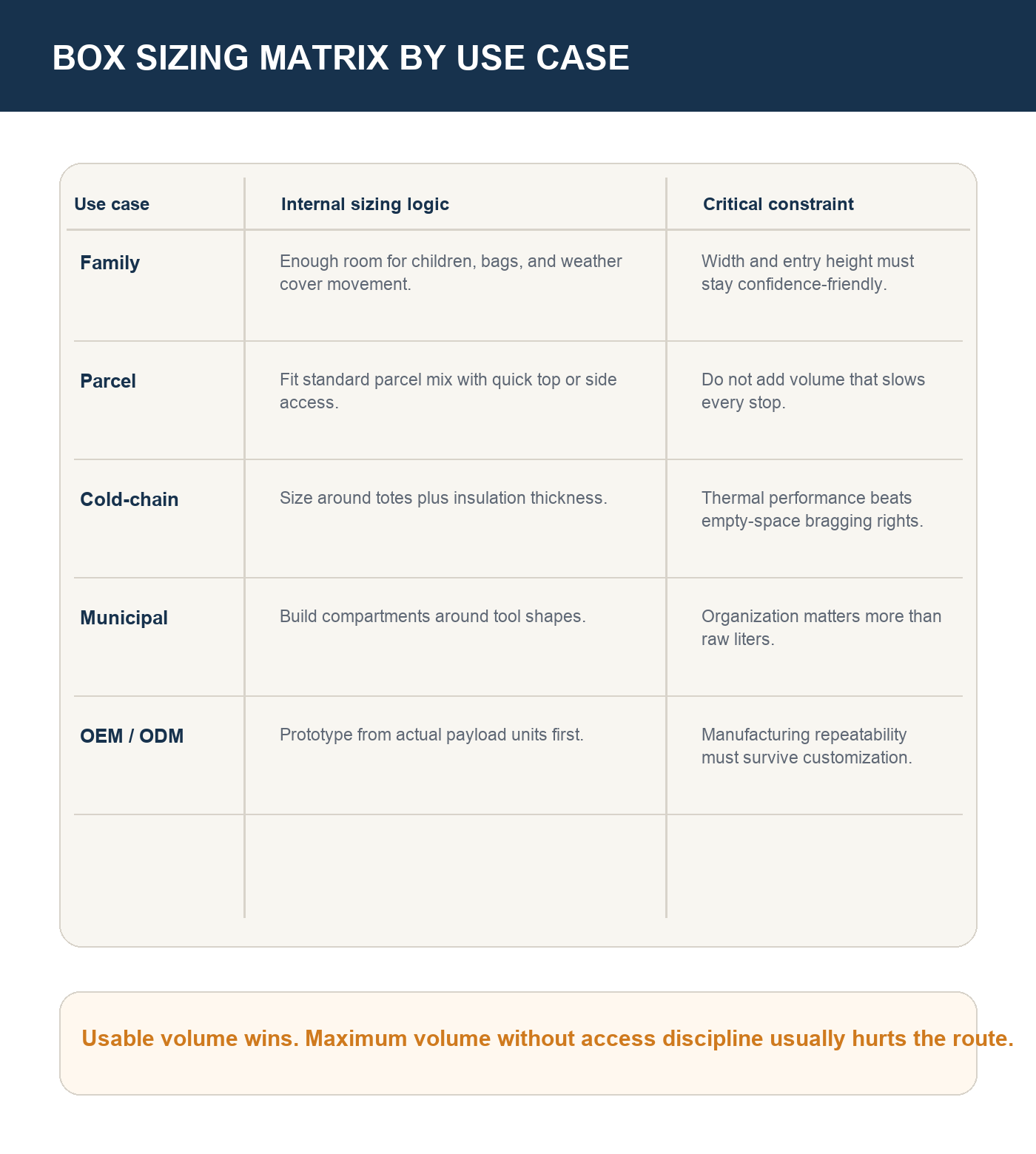
Ein einfaches Dimensionierungsframework nach Anwendungsfall
| Anwendungsfall | Praktische Größenlogik | Was am wichtigsten ist |
|---|---|---|
| Family transport | Moderate Breite, sicheres Sitzen, Wetterabdeckungskompatibilität | Fahrersichtbarkeit, Kindkomfort, Ein- und Ausstieg |
| Paketzustellung | Maximal nutzbarer Raum innerhalb stabiler Handhabungsgrenzen | Stoppeffizienz, Stapelung, Abschließbarkeit |
| Lebensmittel / Kühlkette | Innenbeutel-Passform plus Isolierungsdicke | Wärmespeicherung, Hygiene, Versiegelung |
| Kommunal / Service | Unterteilte Geometrie statt reine Liter | Werkzeugzugang, Trennwände, Servicehaltbarkeit |
| OEM / ODM kundenspezifisches Projekt | Größe definiert durch Nutzlast-Einheit und Produktionswiederholbarkeit | Fertigbarkeit, Montagestandard, Branding |
Was kundenspezifische Konfiguration tatsächlich bedeutet
Viele Käufer sagen, sie brauchen eine “kundenspezifische Frachtbox”, aber Individualisierung kann sehr unterschiedliche Dinge bedeuten. Es hilft, kosmetische Änderungen von operativen Änderungen zu trennen.
Kosmetische Individualisierung
- Farbabstimmung
- Logo-Aufkleber oder -Folien
- Oberflächengrafiken
- Gebrandete Regenschutzabdeckungen oder Deckel
Diese Änderungen sind wichtig für die Markenidentität, aber sie verändern nicht die Workflow-Leistung der Box.
Funktionale Individualisierung
- Front- oder Seitenöffnungstüren
- Obere Deckel oder geteilte Deckel
- Isolierte Innenauskleidung
- Abnehmbare Regale oder Trennwände
- Schlosssysteme
- Entwässerungsmerkmale
- Aussparungen für Ladegerät- oder Batteriezugang
- Kindersitz- und Gurt-Schnittstellen
- modulare Befestigungspunkte
Dies ist die Ebene, die bestimmt, wie schnell der Fahrer das Fahrzeug beladen, entladen, reinigen, sichern oder umkonfigurieren kann. Regen’s Seite zur Anpassung der funktionalen Konfiguration ist hier relevant, weil sie das Lastenrad als ein System darstellt, das um Nutzlast, Route und Betreiberanforderungen herum aufgebaut ist, statt als einen generischen Rahmen mit einer angebrachten Box.
Welchen Einfluss die Box auf Endnutzer hat
Die Box verändert das Nutzererlebnis, selbst wenn Motor, Rahmen und Bremsen gleich bleiben.
Für Familienfahrer
Die Box bestimmt, wie einfach es ist, Kinder hineinzuheben, sie sicher anzuschnallen, Wetterschutz hinzuzufügen und tägliche Gegenstände organisiert zu halten. Scharfe Wände, eine ungünstige Überstiegshöhe oder eine schlechte Integration der Regenabdeckung können ein Fahrrad weniger nutzbar erscheinen lassen, lange bevor der Fahrer die Grenzen des Motors erreicht.
Für Lieferfahrer
Die Box beeinflusst jeden Stopp. Wenn Fahrer sich ungeschickt bücken müssen, in gestapelten Paketen wühlen oder mit einem langsamen Verschlusssystem kämpfen, sinkt die Routenleistung, selbst wenn das Fahrrad mechanisch einwandfrei ist. Boxform und Zugriffsmuster beeinflussen direkt die Lieferungen pro Stunde.
Für Flottenmanager
Die Box beeinflusst Reinigungszeit, Schadensraten, Ersatzkosten und Routeneignung. Eine gut gestaltete Standardbox vereinfacht auch die Schulung, weil alle Fahrer mit derselben Ladelogik interagieren.
Für OEM- und Private-Label-Käufer
Die Box wird Teil der Produkt-Markt-Passung. Ein familienorientiertes Fahrrad mit einer industriell wirkenden übergroßen Box sendet das falsche Signal. Ein kommerzielles Flottenfahrrad ohne abschließbare oder fachfertige Option kann den tatsächlichen Arbeitsablauf des Betreibers verfehlen.
Reale Konfigurationslogik nach Branche
Hier wird die Auswahl kommerziell nutzbar.
Familienmobilität
Empfohlene Logik:
- Box mit moderater Breite
- langlebige Kunststoff- oder Mischmaterial-Hülle
- Kompatibilität mit Kindersitzen
- Unterstützung für Wetterabdeckung
- abgerundete Kanten und einfache Einstiegshöhe
Das Ziel sind Vertrauen, Komfort und Wettertauglichkeit, nicht maximales Volumen.
Paket- und Last-Mile-Lieferung
Empfohlene Logik:
- große kubische Box mit effizientem Zugang von oben oder von der Seite
- langlebige Hülle aus geformtem Kunststoff oder HDPE
- Schlossoption
- Innenlayout, das zu Paketgrößen passt
- Außenflächen, die für Branding geeignet sind
Die Priorität liegt auf schnellen wiederholten Stopps mit vorhersehbarer Ladelogik. Wenn Branding wichtig ist, zählen saubere flache Oberflächen und wiederholbare Folienqualität mehr als Premium-Oberflächen.
Lebensmittel-, Gastronomie- und Pharmadistribution
Empfohlene Logik:
- isolierte Struktur
- abwaschbares Inneres
- versiegeltes Öffnungssystem
- Innenvolumen basierend auf Behälterabmessungen, nicht auf rohem Leerraum
- Temperaturkontrollstrategie, dimensioniert auf die Routendauer
Dies ist die Branche, in der Isolationsdicke, Hygiene und thermische Leistung zusätzliche Komplexität rechtfertigen. Eine Box, die die Waren nur “aufnimmt”, reicht nicht aus, wenn Temperaturabweichung das Dienstmodell zerstört.
Kommunale und Wartungsflotten
Empfohlene Logik:
- Nutzbox aus Aluminium oder Mischmaterial
- Trennwände und abschließbare Fächer
- Hardware-Befestigungspunkte
- einfache Reinigung und Zugang für Feldreparaturen
- Abmessungen passend zu Werkzeugen und Ersatzteilen
Diese Käufer brauchen normalerweise ein Arbeitsfahrzeug, kein Verbraucher-Lastenrad. Das beste Design sieht oft eher wie ein kompaktes mobiles Service-Modul aus als wie eine Einkaufsbox.
OEM-/ODM- und White-Label-Programme
Empfohlene Logik:
- Material basierend auf Produktionsumfang und Anpassungstiefe wählen
- Befestigungsschnittstellen früh standardisieren
- Zugriffslayouts testen, bevor Werkzeuge freigegeben werden
- Boxabmessungen mit dem realen Nutzlastmuster des Zielmarkts abstimmen
- Marketing-Anpassung von struktureller Anpassung trennen
This is why many B2B buyers should prototype with actual payload units before finalizing the box. Fixing a loading mistake after tooling or production setup is much more expensive than refining the geometry up front.
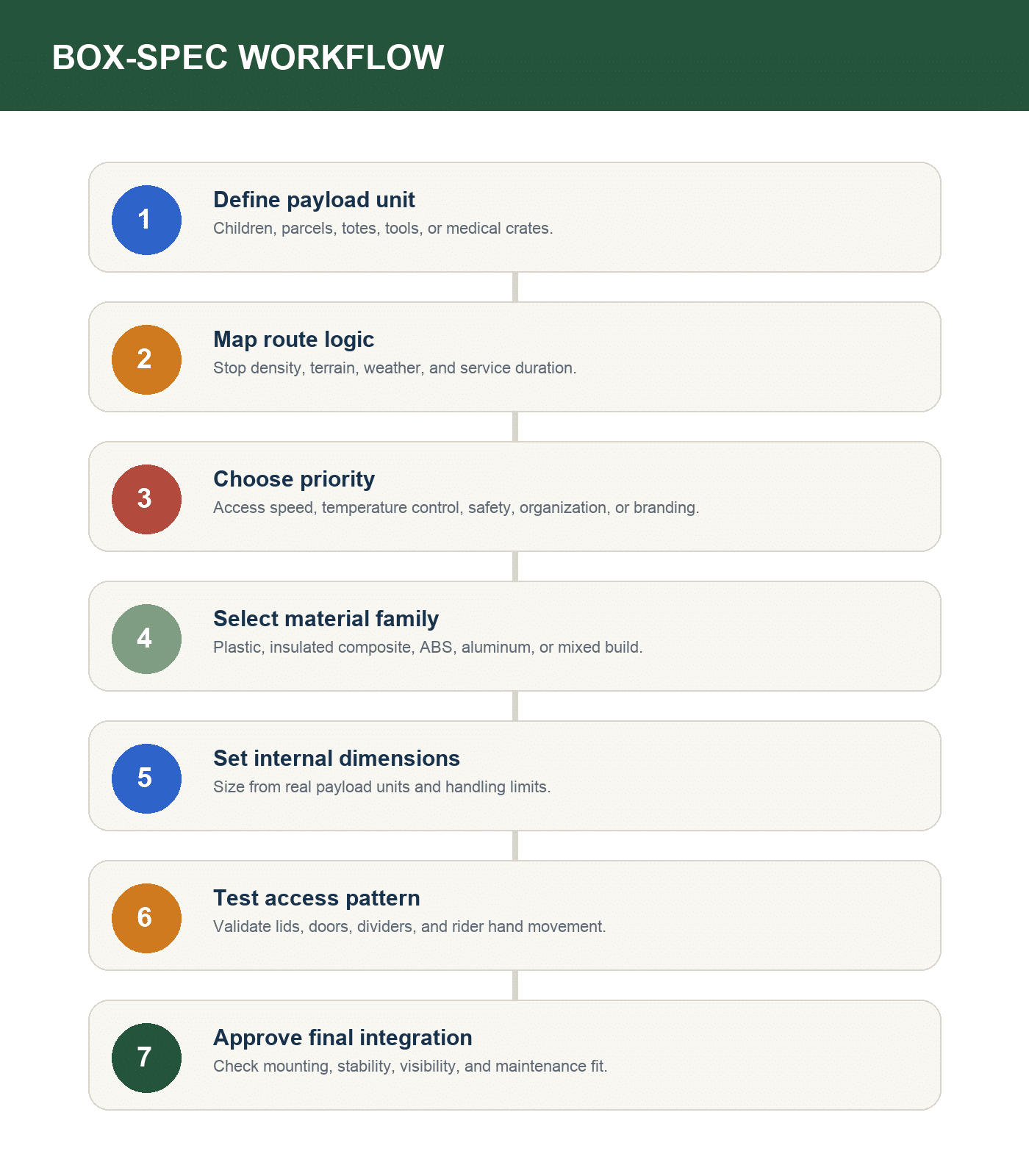
How to Implement a Better Box-Spec Workflow
If you are specifying a cargo bike box for a new product or fleet, use a decision sequence like this:
- List the payload units the box must carry on a normal day.
- Rank the route conditions: flat urban, mixed terrain, cold-chain, high-stop density, family transport, or service work.
- Decide whether the critical factor is access speed, temperature control, child safety, modular organization, or brand appearance.
- Choose the base material family that best fits that priority.
- Define internal dimensions from payload units and handling limits, not from a competitor’s box.
- Test door, lid, and divider concepts against real loading behavior.
- Confirm that the box still supports the bike’s stability, rider visibility, and maintenance plan.
That implementation discipline is what turns the box from a cosmetic accessory into an operating asset.
Practical Selection Mistakes to Avoid
- choosing the box before defining the payload unit
- copying a family-bike box for a commercial delivery workflow
- treating insulation as optional when temperature consistency is part of the service
- ignoring rider access time at each stop
- overvaluing raw volume and undervaluing handling
- approving custom geometry before testing real packing behavior
The Most Useful Way to Think About Cargo Boxes
The box is the interface between the cargo bike and the job it is supposed to do. Materials determine durability and manufacturability. Size determines handling and payload fit. Configuration determines workflow speed and user satisfaction.
When buyers start from those three layers instead of from appearance alone, they make better decisions. That is true whether the bike is carrying children across town, parcels across a city center, chilled groceries to apartments, or tools through a municipal service route.
Verweise
- Regen, Cargo bike box material and sticker custmization
- Regen, Cargo bike functional configuration system customization
- Regen, 10 key factors affecting cargo bike load capacity
- Urban Arrow Service Center, How big is the box of the Urban Arrow Family?
- Urban Freight Lab, Cycle logistics microhubs and transferable containers
- Cold & Co, Insulated cargo bike delivery box
- Bluemooov, Cargo bikes and cargo boxes overview