
 ET
ET  EN
EN  DE
DE  NL
NL  IT
IT  FR
FR  ES
ES  PT
PT  DA
DA  SV
SV  FI
FI  CS
CS  EL
EL  HU
HU  BG
BG  PL
PL  JA
JA  KO
KO 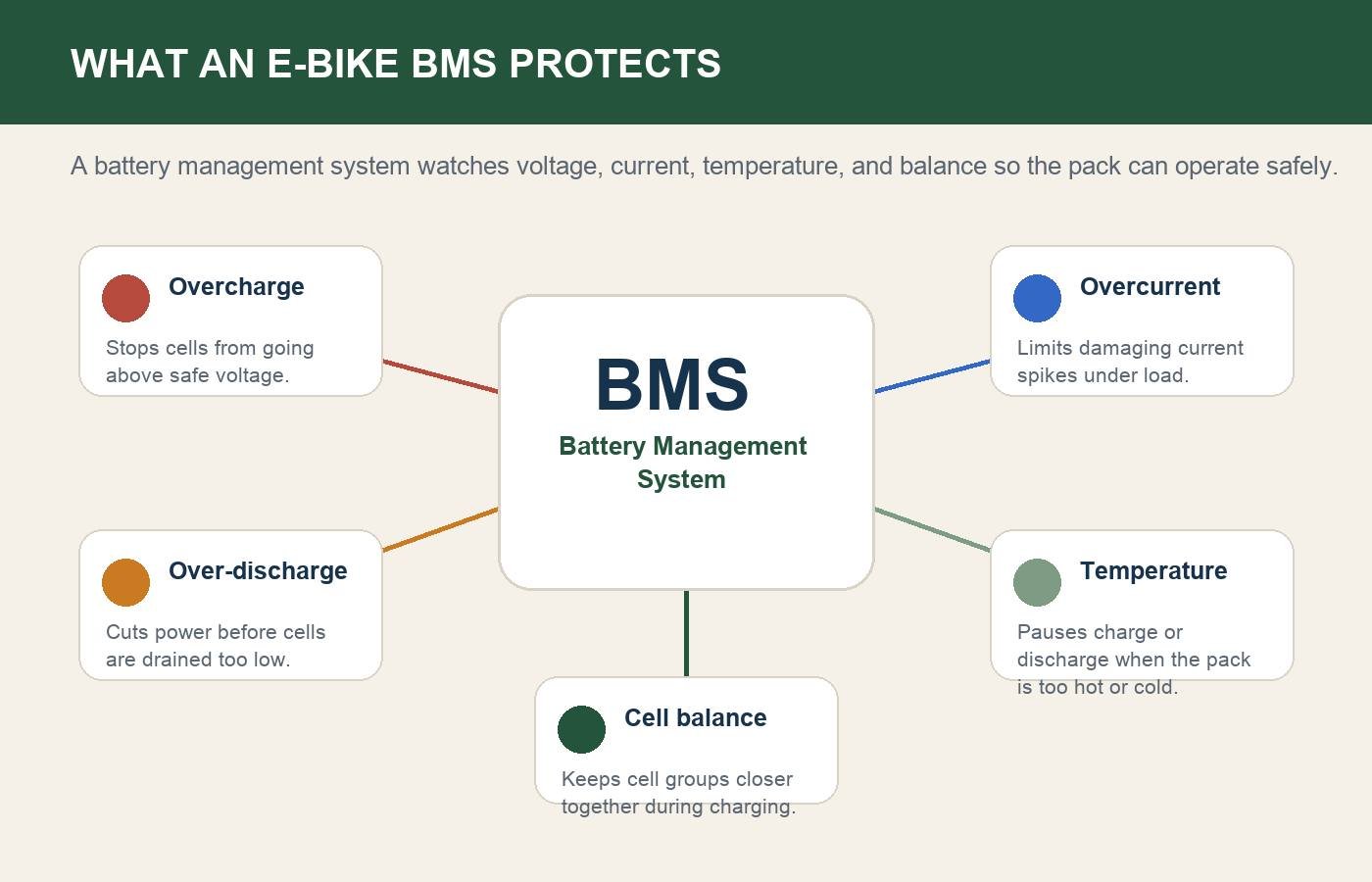
An e-bike BMS is not the motor, the charger, or the dashboard. It is the battery’s built-in management and protection system, and its job is to decide when the pack can charge, when it can discharge, when it should limit power, and when it should shut the system down to protect the cells and the rider.
That matters because most modern electric bikes use lithium-ion batteries. These packs store a lot of energy in a compact case, and they depend on controlled charging, discharge limits, temperature awareness, and cell balancing. A good battery management system does not make a poor battery high quality, but without a functioning BMS even a good pack can become unreliable or unsafe.
For riders, the practical takeaway is simple: when an e-bike loses power suddenly, refuses to charge, cuts out on hills, or shows a battery error, the BMS may be protecting the pack rather than “breaking” the ride. Understanding that difference helps you avoid unsafe DIY fixes, choose better batteries, and explain symptoms more clearly to a dealer or repair shop.
What Is an E-Bike BMS?
An e-bike BMS is a small electronic circuit, usually integrated into the battery pack, that monitors and manages the individual cell groups inside the pack. BMS stands for battery management system.
In plain language, the BMS is the battery’s control room. It watches whether the cells are being charged too high, drained too low, heated too much, asked for too much current, or drifting out of balance with one another. If the pack moves outside its allowed operating range, the BMS can reduce output, stop charging, or disconnect the battery from the bike.
That is why an e-bike battery is more than a box of cells. A complete pack usually includes:
- lithium-ion cell groups
- nickel strips or bus bars connecting the cells
- temperature sensors
- a battery management system board
- charge and discharge connectors
- korpus, kinnitusvahendid ja tihendid
- sidesüsteemi juhtmestik arenenumates süsteemides
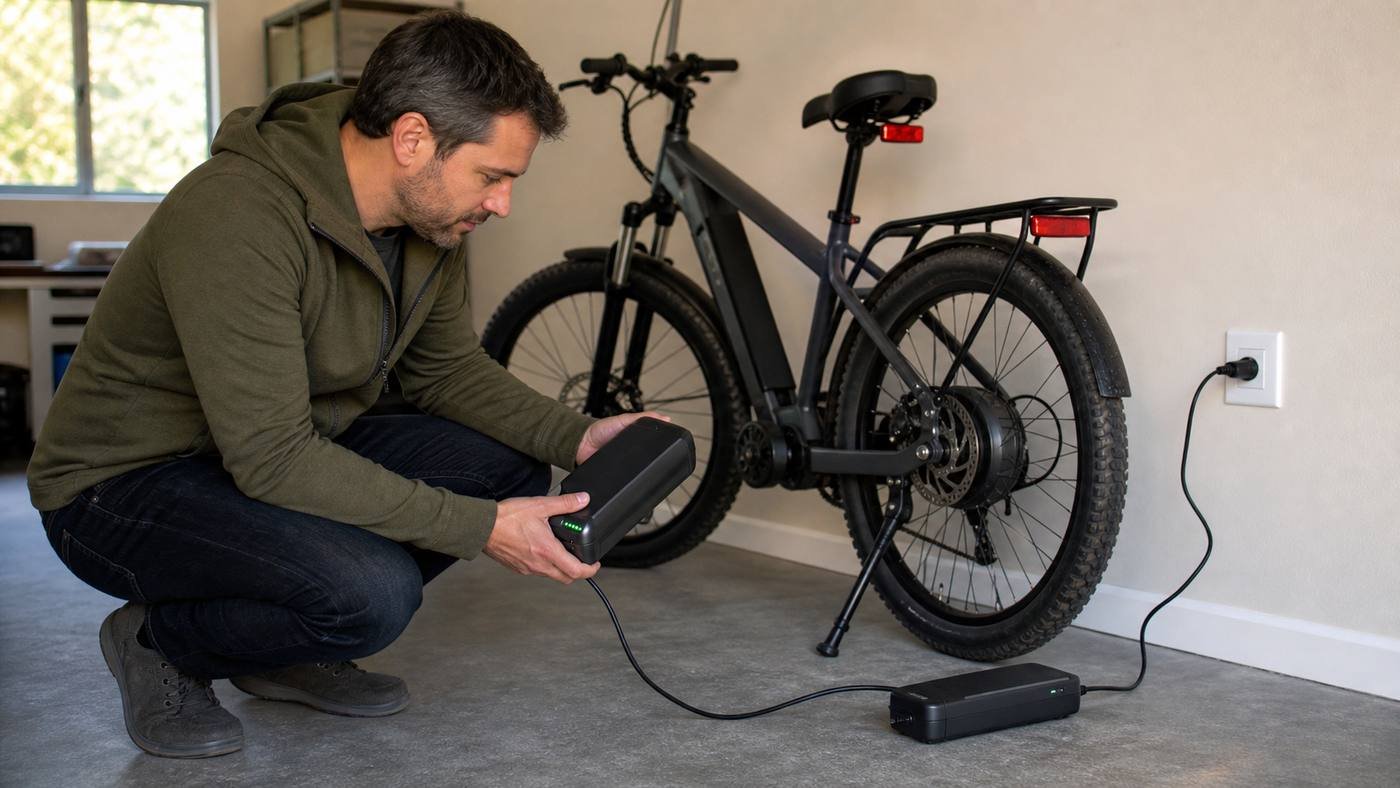
Sõitja tavaliselt BMS-i ei näe. Kuid sõitja tunnetab selle otsuseid iga kord, kui ratas laeb õigesti, väldib ülelaadimist, tasakaalustab laadimise lõpus rakke või lülitub välja, et vältida tõsisemat riket.
Mida teeb e-jalgratta akuhaldussüsteem?
E-jalgratta akuhaldussüsteemi põhiülesanne on hoida aku ohutu tööpiirkonna sees. Erinevad pakid ja kaubamärgid rakendavad seda ülesannet erinevalt, kuid põhifunktsioonid on suures osas sarnased.
| BMS-i funktsioon | Mida see sõitjatele tähendab | Levinud sümptom, kui see käivitub |
|---|---|---|
| Ülelaadimiskaitse | Peatab rakugruppide pinge ületamise maksimumist | Laadija lõpetab vara või aku ei võta laengut vastu |
| Ületühjenemiskaitse | Takistab rakkude liiga madalale tühjenemist | Ratas lülitub väga madala laengu või tugeva pingelanguse korral välja |
| Ülevoolukaitse | Piirab voolutõuse, mis võivad kahjustada rakke või juhtmestikku | Väljalülitumine järskudel tõusudel, kõvadel startidel või raskete koormuste korral |
| Temperatuurikaitse | Blokeerib ohtliku laadimise või tühjenemise, kui pakk on liiga kuum või liiga külm | Aku viga pärast kuuma, külma hoidmist või rasket kasutust |
| Rakkude tasakaalustamine | Hoiab rakugruppe laadimise ajal lähemal | Stabiilsem ulatus ja täielikum laadimine aja jooksul |
| Lühisekaitse | Ühendab paki lahti ohtlike elektririkete korral | Kohene väljalülitumine või väljundi puudumine |
Ülelaadimiskaitse
Liitiumioonrakke ei tohi laadida üle nende ettenähtud pingepiiri. Ülelaadimine võib rakke stressata, lühendada aku eluiga ja suurendada ohutusriski. BMS jälgib rakugruppe ja peatab laadimise, kui üks grupp jõuab oma piirini.
This is one reason you should use the charger supplied or approved by the bike or battery manufacturer. A charger and BMS are designed to work together. A mismatched charger can create a problem that the BMS has to fight, and in low-quality systems the protection may not be enough.
See also: ebikebatteries.com
2. Draining lithium-ion cells too low can permanently damage them. The BMS prevents that by cutting power before the cells fall below a critical voltage.
3. To the rider, this can feel frustrating. The display may still show some charge, then the bike turns off under load. But if the pack voltage drops too far during a hill, cold ride, or heavy cargo start, the BMS may disconnect output to protect the cell groups. That is a protective event, not a setting to bypass.
4. An e-bike motor can demand a lot of current during acceleration, climbing, soft terrain, or cargo riding. The BMS watches that current draw. If the demand exceeds the battery’s safe limit, the BMS may cut output.
5. This is common when riders install a higher-power controller on a battery that was never designed for it. The motor may be able to ask for more power, but the battery pack and BMS decide whether that power can be supplied safely.
6. Battery temperature matters during both charging and riding. Charging a very cold lithium-ion battery can be harmful, while discharging a hot pack under heavy load can accelerate aging or create safety concerns.
7. A responsible BMS uses temperature sensors to prevent charge or discharge outside the pack’s allowed temperature range. If a bike refuses to charge after sitting in a freezing garage, or throws an error after hard use on a hot day, temperature protection may be part of the explanation.
8. An e-bike battery is made from many cells arranged into groups. Over time, those groups can drift slightly apart. If one group reaches full or empty earlier than the others, the whole battery becomes limited by that weakest group.
Ületühjenemiskaitse
Draining lithium-ion cells too low can permanently damage them. The BMS prevents that by cutting power before the cells fall below a critical voltage.
To the rider, this can feel frustrating. The display may still show some charge, then the bike turns off under load. But if the pack voltage drops too far during a hill, cold ride, or heavy cargo start, the BMS may disconnect output to protect the cell groups. That is a protective event, not a setting to bypass.
Ülevoolukaitse
An e-bike motor can demand a lot of current during acceleration, climbing, soft terrain, or cargo riding. The BMS watches that current draw. If the demand exceeds the battery’s safe limit, the BMS may cut output.
This is common when riders install a higher-power controller on a battery that was never designed for it. The motor may be able to ask for more power, but the battery pack and BMS decide whether that power can be supplied safely.
Temperatuurikaitse
Battery temperature matters during both charging and riding. Charging a very cold lithium-ion battery can be harmful, while discharging a hot pack under heavy load can accelerate aging or create safety concerns.
A responsible BMS uses temperature sensors to prevent charge or discharge outside the pack’s allowed temperature range. If a bike refuses to charge after sitting in a freezing garage, or throws an error after hard use on a hot day, temperature protection may be part of the explanation.
Rakkude tasakaalustamine
An e-bike battery is made from many cells arranged into groups. Over time, those groups can drift slightly apart. If one group reaches full or empty earlier than the others, the whole battery becomes limited by that weakest group.
Cell balancing helps keep those groups closer together, usually near the top of charge. This is one reason occasional full charges can be useful when the manufacturer recommends them. It gives the BMS time to balance the pack. That does not mean every battery should sit at 100 percent all the time; follow the battery maker’s storage guidance.
E-Bike BMS vs Charger vs Controller
Riders often mix up the battery management system, charger, and motor controller because all three can affect power delivery.
The charger converts wall power into the correct charging output for the battery. It should match the battery voltage, connector, and manufacturer specification.
The BMS lives in or near the battery pack. It supervises the pack and can allow or block charging and discharging.
The controller manages power from the battery to the motor. It interprets signals from the display, throttle, pedal assist sensor, brake cutoffs, and motor sensors.
Those three parts work as a system. If the bike cuts out on a hill, the cause might be BMS overcurrent protection, a weak battery group, a controller fault, a loose connector, brake sensor behavior, or voltage sag from an aging pack. That is why good diagnosis looks at the whole electrical system instead of blaming one part immediately.
If you want to understand the rider-facing numbers that make this easier to diagnose, read our guide to what the numbers on your e-bike dashboard really mean. Battery percentage, voltage, watts, and error codes can tell a more useful story when you know what they are trying to show.
Common E-Bike BMS Terms Riders See
You do not need to become an electrical engineer to understand BMS language. These are the terms most riders and buyers should recognize.
Voltage
Voltage is the electrical pressure of the pack. A “48V” e-bike battery is usually a nominal rating, not the exact voltage at every moment. The actual pack voltage is higher when full and lower as it discharges.
The BMS uses voltage limits to prevent overcharge and over-discharge.
Current and amps
Current, measured in amps, is the flow of electricity. High current demand happens during hard acceleration, climbing, and heavy cargo use.
If a controller asks for more current than the BMS allows, the battery may cut output.
Continuous discharge rating
This describes how much current the battery can supply steadily. A pack that is fine for a commuter bike may not be suitable for a heavier cargo bike or a modified high-power build.
Peak discharge rating
Peak current is a short burst rating. It should not be confused with what the battery can deliver all day.
Cell group
Cells inside the pack are arranged into groups. If one group becomes weaker than the others, the BMS may stop discharge earlier because the weakest group hits the low-voltage limit first.
Rakkude tasakaalustamine
Balancing is the process of keeping cell groups closer in voltage. Better balance usually supports more predictable range, charging, and pack longevity.
BMS fault
A BMS fault is a protection or communication problem reported by the battery system. It does not always mean the BMS board itself is broken. It can also mean the BMS detected low voltage, heat, overcurrent, bad communication, or a cell-group imbalance.
Signs an E-Bike BMS May Be Protecting the Battery
A BMS event often appears suddenly because protection systems are designed to interrupt the problem quickly. The important question is whether the event is one-off, explainable, or repeated.
Watch for these patterns:
- the bike cuts power during steep hills or heavy acceleration
- the battery refuses to charge when it is very hot or very cold
- the charger turns green too early but range is poor
- the bike shuts off at moderate displayed charge under load
- the pack only wakes up after being connected to the charger
- the display shows a battery, voltage, or communication error
- the same route now triggers cutouts that never happened before
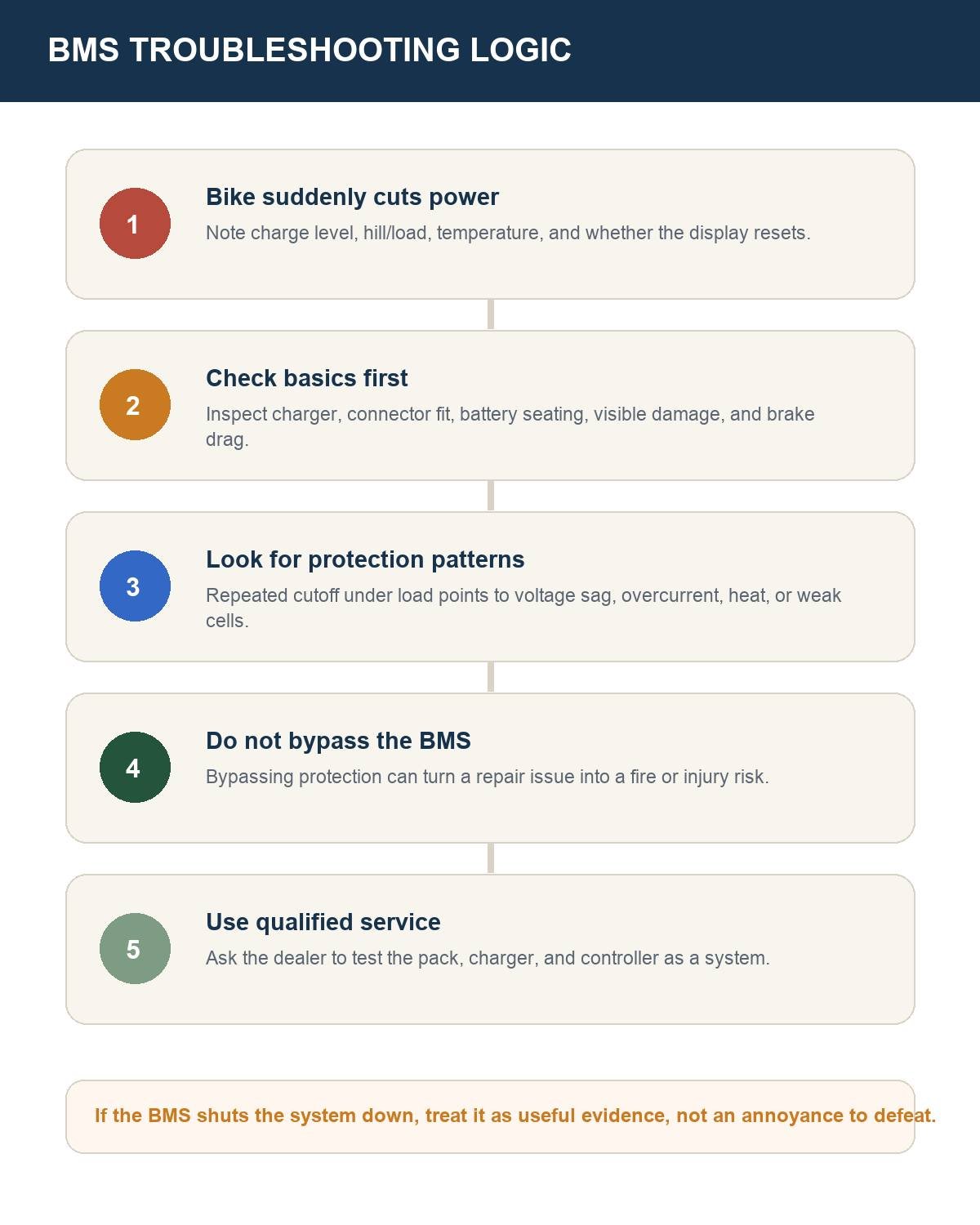
One shutdown after unusual use does not prove the BMS is bad. Repeated cutouts in normal conditions deserve diagnosis.
Start with simple checks: battery seating, connector cleanliness, charger compatibility, tire pressure, brake drag, and whether the problem happens only in cold weather. If those basics are clean, a dealer can test the battery voltage, cell-group balance, charger output, and controller behavior.
For battery aging symptoms, our guide to 8 signs your e-cargo bike battery is degrading gives a practical way to separate normal range variation from real battery health decline.
Can You Reset or Bypass an E-Bike BMS?
Some batteries can be “woken up” after a low-voltage protection event by connecting the approved charger. Some systems also clear temporary faults after the battery cools, warms, or is reinstalled correctly. That is normal.
Bypassing a BMS is different. Riders should not bypass an e-bike BMS to get more power, revive a questionable pack, or defeat a cutoff. The BMS is there because lithium-ion batteries need controlled limits. Bypassing it can remove overcharge, over-discharge, overcurrent, short-circuit, and temperature protection.
The safer logic is:
- Treat the shutdown as evidence.
- Record when it happens: charge level, weather, hill, load, assist mode, and error code.
- Check charger and connector basics.
- Stop using the battery if there is swelling, impact damage, unusual heat, odor, melting, or repeated unexplained cutoff.
- Ask a qualified service provider to test the battery and electrical system.
This is especially important for cargo bikes, delivery bikes, and family e-bikes because the battery is not just powering a leisure ride. It may be carrying children, tools, groceries, or commercial loads.
What to Look For When Buying an E-Bike Battery
A strong BMS is one part of a safe battery, but buyers should look at the whole system.
Match the battery to the bike
Use the voltage, mount, connector, discharge rating, and communication type specified by the bike maker. A battery that physically fits may still be electrically wrong.
Use the approved charger
Do not treat chargers as interchangeable just because the plug looks similar. Voltage, charge profile, connector wiring, and system communication can differ.
Look for recognized system-level safety claims
In North America, UL Solutions describes UL 2849 as a standard for e-bike electrical systems that examines the drive train, battery, and charger system combination. UL 2271 is commonly associated with batteries for light electric vehicle applications. For riders, the key point is that credible testing looks beyond a single marketing phrase and considers whether the battery, charger, motor, controller, and wiring work together safely.
Avoid mystery replacement packs
Cheap replacement batteries can be tempting, but unknown cells, weak assembly, poor welding, mismatched chargers, and vague BMS specifications can create real risk. A low price is not useful if the pack cuts out under load, degrades quickly, or cannot be serviced.
Ask about warranty and service
A reputable battery supplier should be able to explain warranty terms, compatible chargers, storage guidance, expected behavior, and what to do if the BMS reports a fault.
How Riders Can Help the BMS Do Its Job
The BMS protects the battery, but rider behavior still matters.
Use the approved charger and stop using damaged chargers. Charge on a hard, stable surface with airflow around the battery. Do not cover the charger. Avoid charging in extreme heat or freezing conditions unless the manufacturer specifically allows it. Do not store the battery completely empty. Avoid leaving the battery in a hot car or in direct summer sun for long periods.
Hooajaliseks hoidmiseks on olulised laetuse tase ja temperatuur. Paljud tootjad soovitavad liitiumioonakusid hoida osaliselt laetuna jahedas ja kuivas kohas ning kontrollida neid perioodiliselt. Kui talvine hoidmine on asjakohane, vaadake meie juhendit how to store your electric cargo bike for winter.
BMS on viimane elektroonilise kaitse liin, mitte luba akut kuritarvitada. Head laadimisharjumused, õige hoidmine ja ühilduvad osad muudavad BMS-i töö lihtsamaks ja aku eluea pikemaks.
Mida tähendab e-jalgratta BMS tegelikele sõitjatele
Pendeldaja jaoks tähendab BMS seda, et aku peaks laadima prognoositavalt, andma võimsust ohututes piirides ja lülituma välja enne, kui elemendi kahjustus süveneb.
Kaubaratta omaniku jaoks on BMS veelgi olulisem, sest rasked koormused suurendavad vooluvajadust ja pingelangust. Aku, mis tundub tasasel teel hea, võib koormatud tõusudel kaitse käivitada, kui aku, kontroller ja mootor pole hästi sobitatud.
Kullerite ja sõidukiparkide jaoks on BMS osa tööaja planeerimisest. Korduvad kaitsesündmused pole ainult tüütused. Need on operatiivsed signaalid, et marsruut, koormus, aku vanus või elektriline seadistus ei pruugi enam tööle sobida.
Kasutatud e-jalgratta ostjatele võib BMS-i käitumine paljastada varjatud akuriski. Müüja võib öelda, et ratas “vajab lihtsalt laadijat” või “lülitub vahel välja”, kuid need sümptomid võivad viidata väsinud akule, halvale elemendi tasakaalule või kaitserikkele, mis vajab tõelist testimist.
Parim viis e-jalgratta BMS-ile mõelda on see: see pole selleks, et ratas tunduks keeruline. See on selleks, et hoida kõrge energiaga akut kontrollitud töövahemikus. Kui see sekkub, kuulake mustrit enne, kui asendate osi, muudate seadeid või süüdistate mootorit.
KKK
K1: Mida tähendab BMS e-jalgrattal?
A: BMS tähendab akuhaldussüsteemi. E-jalgrattal on see elektrooniline süsteem aku pakendi sees või küljes, mis jälgib pinget, voolu, temperatuuri, elemendi tasakaalu ja kaitselimiite.
K2: Kas e-jalgratas saab töötada ilma BMS-ita?
A: A lithium-ion e-bike battery should not be used without proper battery management and protection. The BMS helps prevent overcharge, over-discharge, overcurrent, overheating, and cell imbalance. Bypassing it is unsafe.
Q3: Does the BMS control e-bike speed?
A: Usually no. Speed and assist behavior are mainly controlled by the motor controller, display settings, sensors, and local class limits. The BMS can limit or cut battery output if current, voltage, or temperature moves outside the pack’s safe range.
Q4: Why does my e-bike battery cut out on hills?
A: Hill cutouts can happen when current demand is high and battery voltage sags under load. Possible causes include BMS overcurrent protection, an aging battery, weak cell groups, cold weather, a mismatched controller, or a loose connection.
Q5: How do I know if my e-bike BMS is bad?
A: A bad BMS is only one possibility. Repeated charging refusal, sudden cutoff, no output, unusual battery errors, or protection events in normal conditions should be tested by a qualified technician. The charger, cells, connectors, controller, and temperature conditions should also be checked.
Q6: Is UL certification the same as having a good BMS?
A: No. A BMS is one component inside the battery system. A safety certification can evaluate a broader electrical system or battery standard, depending on the claim. Buyers should look for credible system-level safety information, compatible chargers, and service support rather than relying on one vague phrase.