
 ET
ET  EN
EN  DE
DE  NL
NL  IT
IT  FR
FR  ES
ES  PT
PT  DA
DA  SV
SV  FI
FI  CS
CS  EL
EL  HU
HU  BG
BG  PL
PL  JA
JA  KO
KO Viimati uuendatud: juuni 2026
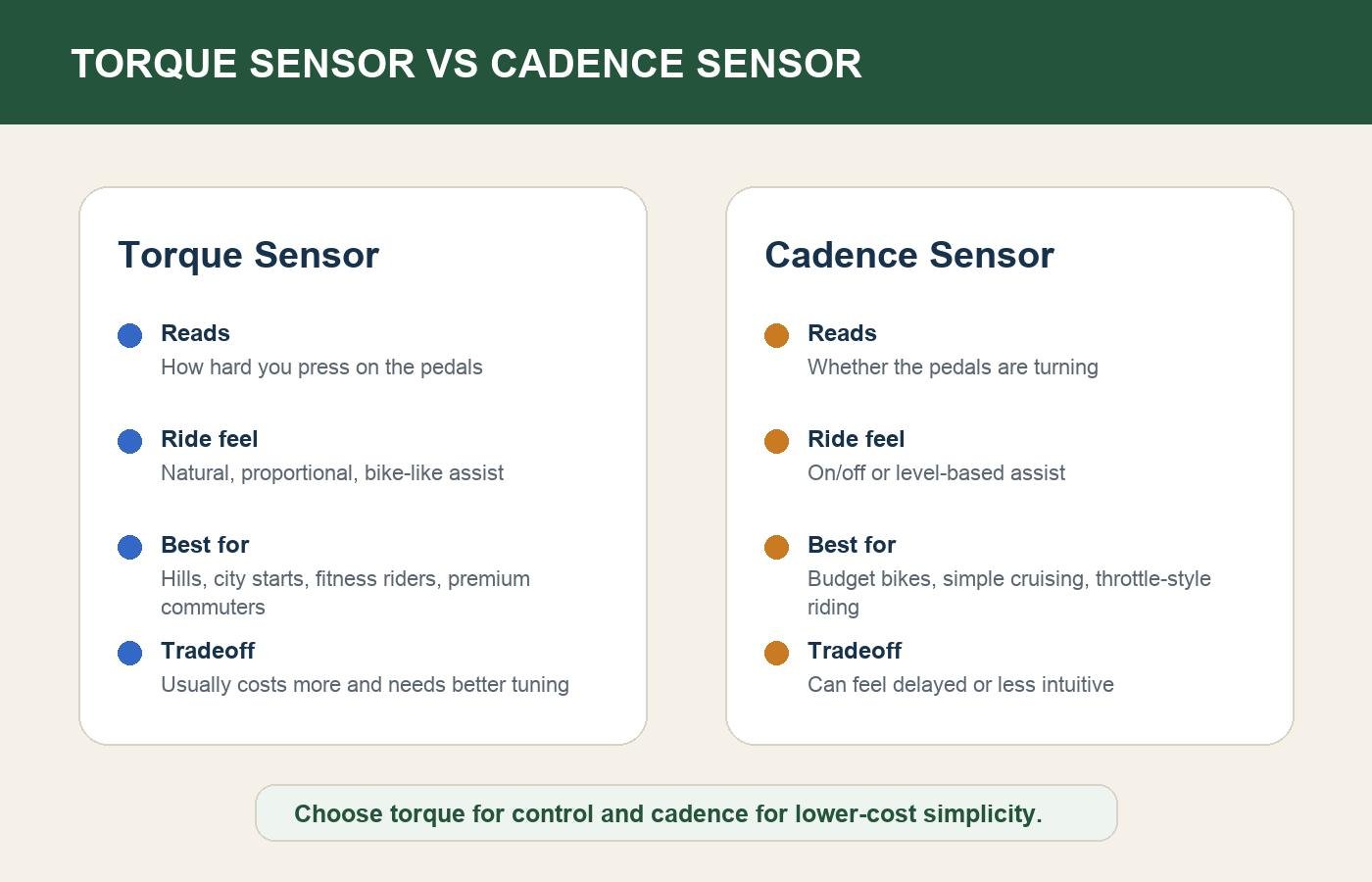
The biggest difference between a torque sensor and a cadence sensor is what the e-bike responds to. A torque sensor responds to pedal pressure, so the motor adds more help when you push harder. A cadence sensor responds to pedal movement, so the motor turns on when it detects that the cranks are rotating.
That single difference changes the whole ride. A torque sensor e-bike feels more like a strong version of your own legs. A cadence sensor electric bike feels more like selecting a power level and letting the bike carry more of the work once you start pedaling. Neither system is automatically wrong, but they fit different riders, budgets, and terrain.
Torque Sensor vs Cadence Sensor: The Simple Difference
Both systems are part of pedal assist. They tell the controller when to send power from the battery to the motor. The difference is the signal they send.
| Funktsioon | Pöördemomendiandur | Taktimõõtja |
|---|---|---|
| What it measures | Pedal force | Pedal rotation |
| Ride feel | Natural and proportional | More on/off or level-based |
| Starts from a stop | Smooth if well tuned | Can feel delayed or surge-like |
| Hill climbing | Usually better control | Depends heavily on assist level and motor power |
| Battery use | Often more efficient | Can use more power if high assist stays on |
| Maksumus | Usually higher | Usually lower |
| Parimad selleks, et | Commuting, hills, fitness, premium bikes | Budget riders, casual cruising, flat routes |
If you want the bike to feel intuitive, choose a torque sensor when your budget allows. If you want a lower-cost e-bike for relaxed riding and do not mind a less refined assist feel, a cadence sensor can still make sense.
What Is an E-Bike Torque Sensor?
An e-bike torque sensor measures the force you apply through the pedals, crank, bottom bracket, or drivetrain. When you press harder, the controller reads that effort and tells the motor to provide more assistance. When you pedal gently, the motor backs off.
Seepärast tundub pöördemomenti tajuv pedaalimisabi sageli loomulikuna. Jalgratas ei küsi ainult “kas pedaalid liiguvad?” Ta küsib “kui palju pingutab sõitja praegu?”
See aitab reaalsetes olukordades:
- alustades peatunult ristmikul
- ronides mäkke koorma või toidukraamiga
- sõites vastutuult
- libisedes läbi rahvarohke jalgrattatee
- hoides akut pikemal pendelrännakul
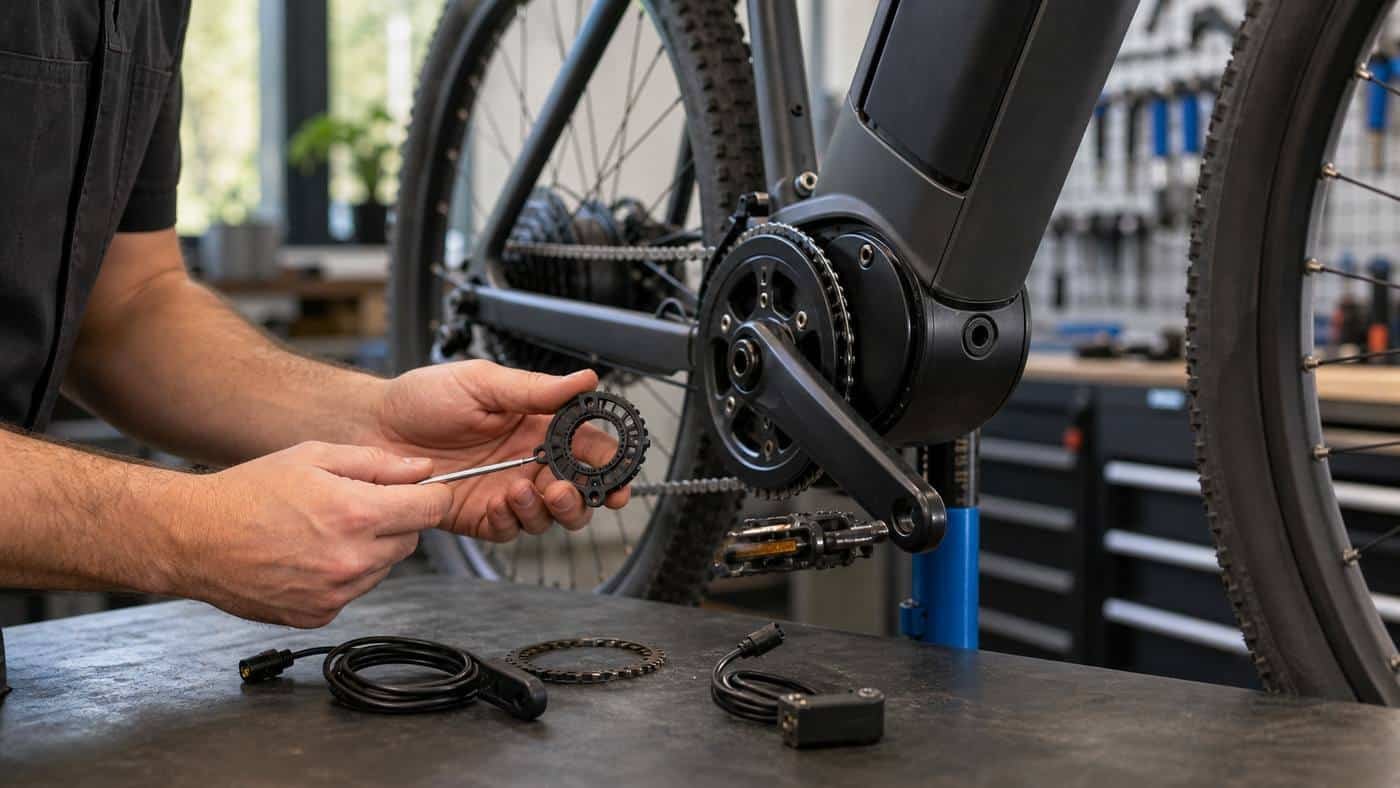
Hästi häälestatud pöördemomentiandur paneb mootori tunduma, nagu oleks see su jalgadega ühendatud. Sa valid ikka abitaseme, kuid selle taseme piires reageerib süsteem pingutusele. Väike pingutus saab kerget abi. Tugev pingutus saab tugevamat abi.
Puuduseks on hind. Pöördemomentiandurid esinevad tavaliselt paremini varustatud pendel-, kauba-, matka- ja jõudlusega elektriratastel. Need vajavad ka head tarkvara häälestust. Odav pöördemomentiandur kehva kontrolleri häälestusega võib ikkagi tunduda kohmakas.
Mis on pöördesagedusanduriga elektriratas?
Pöördesagedusandur tuvastab pedaalide pöörlemise. Kui magnetid või andurisüsteem näevad, et vänt käib ringi, aktiveerib kontroller mootoriabi vastavalt valitud abitasemele.
Lihtsas keeles küsib pöördesagedusandur: kas sa pedaalid või mitte?
Paljudel pöördesagedusanduriga elektriratastel ei muutu abi kuigi palju selle järgi, kui tugevalt sa vajutad. Kui ratas on seatud abitasemele 3, võib see anda programmeeritud koguse võimsust seni, kuni pedaalid liiguvad. See võib tunduda kerge ja lõõgastav, eriti tasasel maal.
Kompromiss on kontroll. Mõnel pöördesagedussüsteemil on väike viivitus alustamisel või peatamisel. Mõni võib abi alustades tõukama hakata. Mõni soodustab “kummituspedaalimist”, kus sõitja keerab pedaale kergelt, samal ajal kui mootor teeb suurema osa tööst.
That is not always bad. Many riders want that feel. If you are riding flat paths, recovering from fatigue, or choosing a budget e-bike for relaxed local trips, cadence assist may be exactly what you expect.
How Each Pedal Assist Sensor Feels on the Road
The best way to understand torque sensor vs cadence sensor behavior is to imagine the same ride on two bikes.
Starting from a stop
With a torque sensor, the motor responds as soon as you press into the pedals. A good system feels controlled because the motor output rises with your effort.
With a cadence sensor, the motor usually waits until it detects crank rotation. That can create a short delay. Once assist arrives, it may feel like the bike wakes up all at once.
For confident riders, this is manageable. For new riders, seniors, cargo riders, or commuters starting in traffic, smooth launch behavior matters a lot.
Riding up hills
Torque sensors usually feel better on hills because they add power when the rider pushes harder. That makes climbing feel predictable. You can ease off slightly and the bike eases off with you.
Cadence sensors can still climb well if the motor is strong and the assist level is high. But the bike may feel less precise because power is tied more to assist setting than to pedal pressure.
Riding in traffic
Stop-start city riding rewards smooth control. A torque sensor helps because small changes in rider effort produce small changes in motor output.
A cadence sensor can be fine in bike lanes or quiet streets, but it may feel clumsy in tight traffic if assist turns on too abruptly.
Long relaxed cruising
Cadence sensors can shine here. If the route is flat and the rider wants low effort, a cadence sensor e-bike can maintain an easy, moped-like rhythm without requiring much pressure on the pedals.
Torque sensors still work well, but they usually expect more real pedaling effort from the rider.
Which Sensor Is Better for Range?
Torque sensors often help range because the motor output follows rider effort more closely. If you pedal gently on flat roads, the bike does not need to pour in the same power it would use on a hill. This can make assist feel more efficient.
Cadence sensors can use more battery when riders select a high assist level and keep the pedals moving lightly. The bike may continue giving a relatively fixed amount of help even when less power would be enough.
That said, range is not decided by the sensor alone. Real-world range also depends on:
- battery capacity
- motor type and tuning
- rider weight
- rehvirõhku
- kiirus
- hills
- wind
- lasti
- temperature
- stop-start riding
If two otherwise similar e-bikes are ridden by the same person on the same commute, the torque-sensor bike will often feel easier to manage efficiently. But a well-ridden cadence-sensor bike can still deliver good range if the rider uses lower assist levels and keeps tire pressure, drivetrain, and charging habits under control.
For battery behavior and range diagnosis, see our guide to 8 signs your e-cargo bike battery is degrading.
Which Sensor Is Better for Commuting?
For most daily commuters, a torque sensor is better if the price is reasonable. Commuting includes intersections, hills, speed changes, pedestrians, traffic lights, and moments where predictable control matters more than raw motor output.
Choose a torque sensor for commuting if:
- your route has hills
- you ride in traffic
- you carry a backpack, groceries, or child seat
- you want the bike to feel like natural cycling
- you care about battery efficiency
- you are buying a mid-range or premium commuter e-bike
Choose a cadence sensor for commuting if:
- your route is flat
- you want a lower purchase price
- you prefer very light pedaling effort
- you use throttle frequently where legal
- you ride mostly paths, neighborhoods, or short trips
Commuters should also think about local class rules. A sensor does not by itself determine whether a bike is Class 1, Class 2, or Class 3, but assist behavior, throttle availability, and top assisted speed affect where the bike may be legal to ride.
Which Sensor Is Better for Seniors or New Riders?
This depends on the rider.
A torque sensor is often better for riders who want smooth starts, predictable speed control, and a bike that responds naturally to their effort. That can be helpful for seniors, cautious riders, and anyone who dislikes sudden acceleration.
A cadence sensor can be better for riders who have knee pain, fatigue, or limited strength and want the bike to provide more assistance with lighter pedal pressure. Some riders prefer cadence systems because they do not have to push hard to get motor help.
The important detail is tuning. A gentle cadence system with well-controlled start behavior can be easier than a poorly tuned torque system. A harsh cadence system can feel unsettling. When possible, test ride both before buying.
Buying Advice: Torque Sensor vs Cadence Sensor
Kui elektriratas on umbes keskmisest eelarveklassist kallim ja seda turustatakse pendel-, kauba-, matka- või premium-linnarattana, on pöördemomendiandur tugev pluss. See parandab seda, mida sõitja tunneb iga kilomeetri järel: kui loomulikult ratas reageerib.
Kui ratas on odav kokkupandav, cruiser või naabruskonna elektriratas, võib pedaalimisandur olla vastuvõetav kompromiss. See hoiab hinna madalal ja annab siiski kasulikku elektrilist abi.
Kasutage seda kiiret ostuloogikat:
- Valige pöördemomendiandur, kui soovite loomulikku sõidutunnet.
- Valige pöördemomendiandur, kui teie marsruudil on künkaid või liiklust.
- Valige pöördemomendiandur, kui soovite aktiivselt pedaalida.
- Vali kadentsiandur, kui hind on kõige olulisem.
- Vali kadentsiandur, kui sinu marsruut on tasane ja rahulik.
- Vali kadentsiandur, kui soovid väga kerget pedaalimist ühtlasel kiirusel.
Parim e-jalgratas ei ole see, millel on paberil kõige uhkem andur. See on see, mille abisüsteemi käitumine sobib sellega, kuidas sa tegelikult sõidad.
KKK
K1: Kas pöördemomendiandur on parem kui kadentsiandur?
A: Pöördemomendiandur on tavaliselt parem loomuliku sõidutunde, tõusude, pendelrände ja tõhususe jaoks. Kadentsiandur on tavaliselt odavam ja võib olla hea tasasel, rahulikul sõidul.
K2: Mida teeb kadentsiandur e-jalgrattal?
A: Kadentsiandur tuvastab, kas pedaalid pöörlevad. Kui see tuvastab pedaalimise, ütleb see kontrollerile, et anda abi vastavalt valitud abitasemele.
K3: Mida teeb pöördemomendiandur e-jalgrattal?
A: Pöördemomendiandur mõõdab, kui tugevalt rattur pedaalidele vajutab. Seejärel lisab mootor abi proportsionaalselt ratturi pingutusega.
K4: Kas pöördemomendianduriga e-jalgrattad kasutavad vähem akut?
A: Sageli jah, sest mootori võimsus järgib ratturi pingutust täpsemalt. Kuid kogu sõiduulatus sõltub siiski aku suurusest, kiirusest, tõusudest, ratturi kaalust, rehvirõhust ja abitasemest.
K5: Kas kadentsianduriga e-jalgratas suudab tõuse võtta?
A: Jah, kui mootor, ülekanded ja aku on piisavalt tugevad. See ei pruugi tunduda nii täpne kui pöördemomendianduriga jalgratas, sest abi ei ole otseselt seotud pedaalivajutusega.
K6: Kas algajad peaksid valima pöördemomendi või kadentsi?
A: Algajad, kes soovivad sujuvat, jalgrattasarnast juhtimist, peaksid eelistama pöördemomendi tuvastust. Algajad, kes soovivad vähest pingutust ja madalamat hinda, võivad eelistada kadentsi tuvastust, eriti tasastel marsruutidel.
Allikad
- Bosch eBike Systems, ametlikud ajamiüksuse ja anduri kirjeldused.
- Aventon õppematerjal pöördemomendiandurite ja kadentsiandurite kohta.
- Shimano STEPS tugi ja e-jalgratta süsteemi kirjeldused pedaalimisabi käitumise kohta.